He is regarded as one of the most brilliant mathematicians in history. His colorful life has become the stuff of legend. Stefan Banach was a pioneer of functional analysis and a central figure of the Lwów School of Mathematics, one of the most important scientific circles in the history of the discipline.
by Piotr Abryszeński
Stefan Banach’s achievements include numerous scientific papers and several fundamental theorems and concepts, among them the Banach space and the fixed-point theorem. His ideas influenced not only pure mathematics but also theoretical physics, numerical analysis, and the theory of differential equations. It is difficult to identify a field of 20th-century mathematics that did not draw on his work. In practical terms, this means that a significant portion of contemporary mathematical models in physics, engineering, economics, and theoretical computer science are based on the conceptual framework developed by Banach and his school.
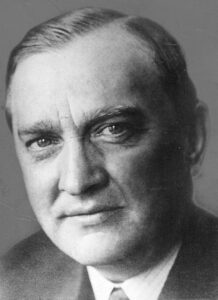
My Greatest Discovery? Stefan Banach!
Stefan Banach was born on March 30, 1892, in Kraków. His childhood was not easy. He was raised by a foster family, never knew his mother, and had sporadic contact with his father. It was not until World War II that he received a letter from his father, in which he tried to explain his actions. Despite modest circumstances, Banach pursued his education and quickly revealed an extraordinary talent not only in mathematics but also in languages. As early as middle school, he showed an interest in subjects far beyond the standard school curriculum. At the same time, he earned extra money by tutoring, although he helped his classmates entirely selflessly.
In 1910, Banach graduated from high school and began his studies at the Lwów Polytechnic. When World War I broke out, he returned to his native Kraków and pursued mathematics as a hobby. Fortunately, he was not conscripted into the army due to his left-handedness and poor eyesight. During this period, he worked as a bookseller and devoted his free time to self-education. He enjoyed spending his evenings walking and discussing complex scientific problems.
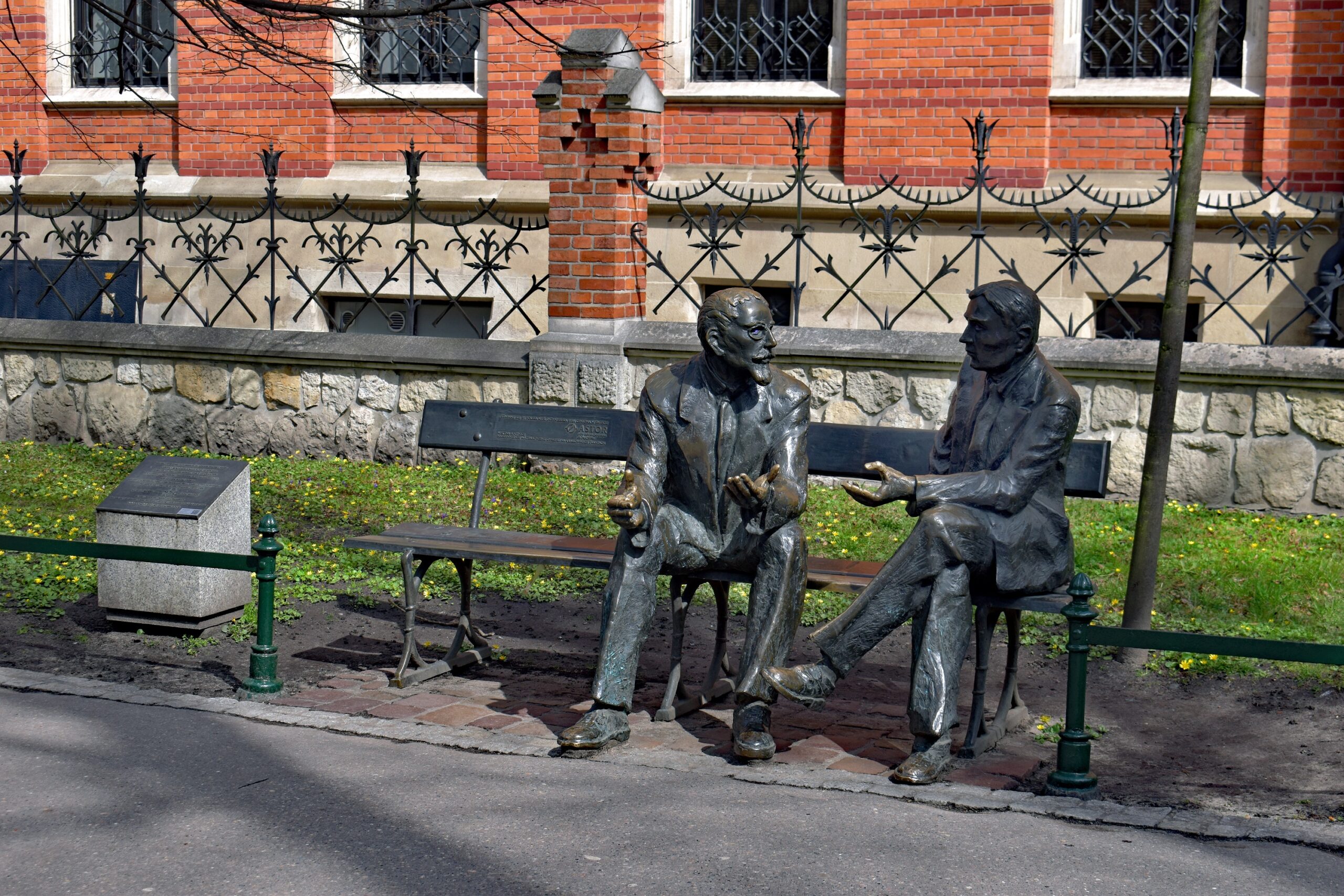
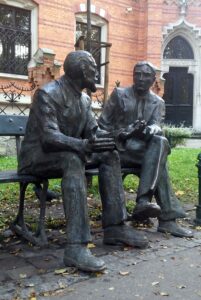
In the summer of 1916, Hugo Steinhaus, by then a renowned mathematician, was visiting Kraków. While walking through Planty Park, he overheard a conversation between two young men in which the phrase “Lebesgue integral” was mentioned. At the time, this was a completely new concept, only recently introduced into mathematical terminology. Surprised, Steinhaus stopped to listen. The conversation was led by two young men, Stefan Banach and Otto Nikodym.
He began talking to the two strangers, mentioning a problem he was working on at the time. A few days later, Banach came to him and presented a solution. The problem concerned the average convergence of Fourier partial sums. Steinhaus already knew he had met a true genius. They soon published their results in their first joint paper. Thus began a career that, over the course of a dozen years, made Lwów one of the most important places on the world map of mathematics.
Their meeting resulted in a long-term collaboration and changed the history of mathematics. In 1920, thanks to Steinhaus’s support, Banach was appointed assistant professor at the Lwów Polytechnic University. Two years later, he headed a department at the Institute of Mathematics of the Jan Kazimierz University in Lwów. Years later, when asked about his most significant discovery in mathematics, he would say that it was the discovery of Stefan Banach.
Congratulations! You’re a Doctor!
Banach’s aversion to academic procedures was legendary. For him, simply engaging in research was a great adventure and entirely sufficient. He already had achievements to his name that would have satisfied many other scholars, and he himself was in no hurry to formally complete his studies. He didn’t even intend to write his master’s thesis. When colleagues suggested he finally write a doctoral dissertation, he replied in a disarming calm tone that “he still had time” and that perhaps he would come up with something better than what he had achieved so far.
A popular anecdote has it that his colleagues eventually decided to take matters into their own hands. The regulations at the time permitted the submission of a doctoral dissertation without obtaining a master’s degree (Banach had completed four years of studies, which was sufficient at the time). The results of his work were recorded and circulated in the form of notes, sketches, and coffeehouse notes. An assistant was also dispatched to ask Banach questions and meticulously record his answers. This brilliant mathematician, an enthusiast of scientific debate, readily provided answers. In this way, all the data was gathered into a coherent treatise. Of course, Banach remained unaware.
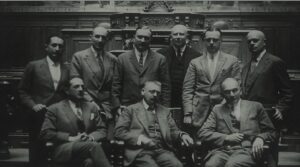
One day, in mid-1920, he was approached in the hallway of Jan Kazimierz University: “Could you please come to the dean’s office? There are some people there who have some mathematical problems, and only you can explain them.” It didn’t take long. Banach eagerly provided answers, unaware that he was taking his doctoral exam before a committee that had traveled from Warsaw. He received top marks.
The results of his doctoral thesis were published in the text “On Operations in the Abstract and Integral Complexes,” which contained the fundamental theorems of a new mathematical discipline–functional analysis. In this work, Banach introduced the concept of a “B-space,” which Maurice Fréchet later called a Banach space. Soon, the whole world was talking about Banach algebra, the Banach integral, and many other things.
In 1922, he earned his habilitation and was appointed associate professor. Five years later, he was a full professor, and in 1924, he became a corresponding member of the Polish Academy of Arts and Sciences. Together with Hugo Steinhaus, he founded the famous journal “Studia Mathematica,” devoted exclusively to functional analysis. He never lost his distaste for academic formalities. When informed that the Faculty Council or another academic meeting was to take place in a few hours, he would reply, “Oh! I know where I definitely won’t be!”
The Scottish Café
Banach was not a typical scientist of his era. He disregarded convention and supported Pogoń Lwów, one of the most successful football teams of pre-war Poland. He spent hours with his colleagues at the Scottish Café. As Hugo Steinhaus recalled, the atmosphere at the Scottish Café fostered intense, informal scientific work.
Discussions took place at café tables, without a schedule or academic hierarchy. Professors and young mathematics students engaged in hours-long debates, formulating hypotheses, refuting them, and moving immediately on to the next problem. The café became an extension of the university—and for some, its true center.
Alongside Banach and Steinhaus, regular participants included Antoni Łomnicki, Stanisław Ulam, Stanisław Mazur, Stanisław Ruziewicz, Eustachy Żyliński, and Władysław Orlicz. A visit to the Scottish Café (also colloquially known as the Scottish Academy) was a highlight for many renowned mathematicians from other Polish cities, as well as from France, the United States, and Germany. The café’s doors were also open to talented students. Over coffee (and not only over coffee!), they broke away from academic feudalism, creating an atmosphere of intimacy and creative teamwork.
What distinguished the mathematicians at the Scottish Academy was their distinctive style of scientific work: an emphasis on intuition, bold hypotheses, and lively discussion. Formal writing often came later. Banach, a central figure in this community, preferred conversation to solitary work at a desk. As historians of mathematics emphasize, many of his ideas crystallized during these café debates. Some lasted several hours, and the longest–according to participants’ recollections–lasted as long as forty hours!
Stanisław Ulam, who later worked at Los Alamos on the Manhattan Project, recalled that the intensity of thought, the capacity for deep concentration, and the ability to sustain discussions were common features of the Scottish Academy and of the work on the atomic bomb. But in his opinion, nothing matched the talks with Banach, Mazur, and Steinhaus.
Mathematical problems were initially written directly on the café’s marble tables or on napkins. After hours of discussion, students were sent to the café to copy the working notes. One day, however, one day, an unsuspecting cleaning lady erased the notes of the Lwów mathematicians.
The problem was solved by Banach’s wife, who gave them a simple notebook purchased for 2.5 złoty. From then on, the café staff would hand it to the mathematicians to discourage them from writing on the tabletop. It became known as the “Scottish Book.”It contained mathematical problems formulated during café meetings, often accompanied by prizes for their solution–ranging from a bottle of wine, to dinner at the prestigious Hotel George, to a live goose! Some of these problems were not solved until decades later. Some remain unsolved to this day. The last entry, dated May 31, 1941, was written by Steinhaus. A month later, the Germans entered Lwów.
Banach himself loved working in the hustle and bustle. He preferred a café to a quiet office or library. That’s where he focused best. When the café was closed, he’d head to the train station and work on math problems. Sometimes, after long sessions, he’d rush straight to class, often arriving late. He’d say, “Although the class started a little later than planned, we’ll finish early.” Students valued Banach as a lecturer who patiently and clearly explained complex concepts. This skill led to the creation of several middle school algebra textbooks, which were used by subsequent generations of students. There was also a downside: as a café enthusiast who was utterly incapable of saving money, he fell into debt. Wanting to get out of debt, he accepted a commission and became a textbook author.
There’s no price for it!
Banach’s fame extended far beyond Lwów. At the behest of Norbert Wiener, the founder of cybernetics, John von Neumann visited Lwów several times to persuade the Polish mathematician to work in the United States. During his July 1937 visit, an impatient Banach asked von Neumann, “How much are you offering?” He handed him a check on which he had written the number “1” and asked Banach to add as many zeros as he saw fit. Banach replied with a smile, “That’s too small a sum to leave Poland.”
The idyll was short-lived, however. When the Soviet army occupied Lwów in September 1939, Banach was dean of the Faculty of Mathematics and Physics. It was then that he first met his half-sister. Having never experienced the love of his parents or the warmth of a family home, he was all the more determined to provide the best possible life for his wife and only son. He was an exemplary husband and a loving father. Upon meeting his half-sister, he not only accepted her but also advised her: “If you need anything, go to the mathematicians and tell them you’re Stefan Banach’s sister. They’ll help you.”
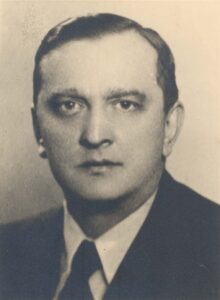
After the German invasion, he was forced to protect himself from repression by the occupying forces and became a lice feeder at Rudolf Weigl’s Institute for Typhus and Virus Research. Banach’s beloved city became the scene of numerous crimes committed by the NKVD, as well as the SS and Gestapo. In July 1941, Lwów professors were murdered by the Germans. The Polish school of mathematics suffered enormous losses. Banach escaped the fate of many of his colleagues, but the long-term deterioration caused by the occupation and his nicotine addiction proved fatal. He developed lung cancer.
On August 31, 1945, Stefan Banach, the brilliant mathematician, died at the age of 53. He was buried at the Łyczakowski Cemetery, beside the renowned poet and novelist Maria Konopnicka. Banach’s funeral turned into a major demonstration by the Polish scientific community still remaining in Lwów. Lwów itself, as a result of the Great Powers’ decision, found itself outside Poland’s borders. The Lwów School of Mathematics passed into history.