Magdalena Abakanowicz was an icon of global contemporary art — a sculptor whose work transcended the boundaries of form, material, and meaning. Known primarily for her monumental Abakans, she created works that explored the essence of humanity–its fragility, strength, and place in history. Her art — organic, moving, and deeply emotional — remains one of the most compelling voices of the 20th century.
by Nina Kucharczyk
Born in 1930 in Falenty, Magdalena Abakanowicz spent her early years in her parents’ manor house, surrounded by old paintings and mementos of the past. Back then, she created works that she hid away in her room, as they did not seem to her something that would commonly be called art. In her recollections, she often returned to nature, which had been important to her from the very beginning and remained an integral part of her life and a constant inspiration. In 1941, she left her hometown and moved with her parents to Warsaw. After the war they moved to Pomerania, where she spent her teenage years in the Tricity. During this time, she devoted most of her time to athletics, winning medals in the Polish championships–once for Bałtyk Gdańsk, once for HKS Tczew, and another time for Gedania Gdańsk.
Eventually, she returned to her first love, art. She never spoke of it in grand terms. In an interview, she recalled that someone told her about an art school in Gdynia. Fascinated by the language of art, she decided to apply there. She tried. She made a dragon. She remembered the professor’s disgusted face. A look she would later encounter many times in the eyes of critics, activists, and those who presumed to decide what was and was not art. The professors unanimously rejected her, claiming that she had no sense of form. So she turned to painting.
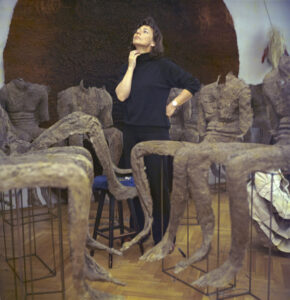
After a year at the State Higher School of Fine Arts in Sopot, she moved to Warsaw, where she continued her studies at the Academy of Fine Arts. In 1954, she graduated with distinction, but at the final exhibition, she looked at her own and her colleagues’ works: all similar, all created under the same dictates. They possessed only one dimension, subordinated to a single, righteous vision. Even then, she was already in conflict with her professors. Like every independent artist, she rejected academicism and dogma.
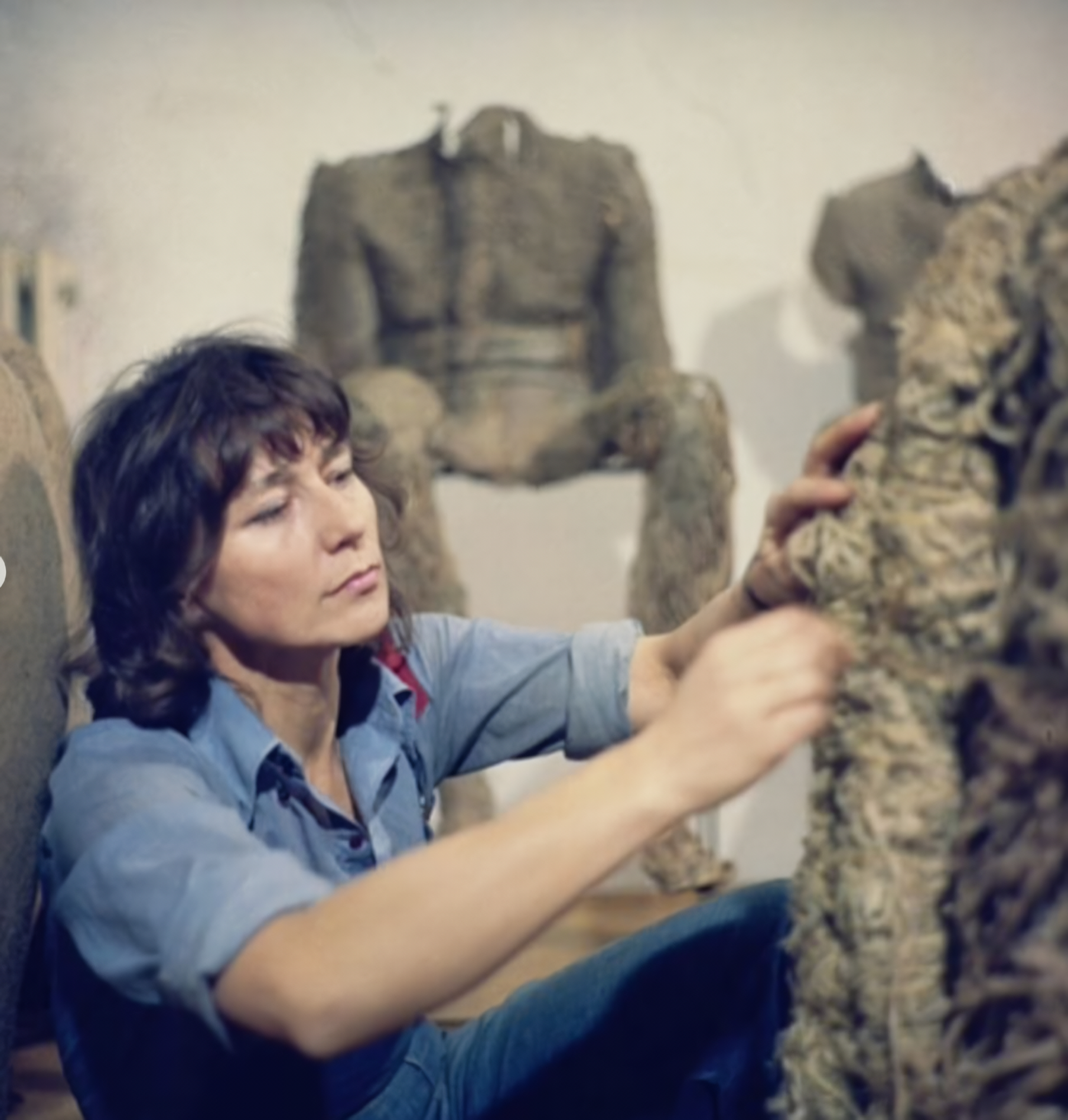
The story behind the creation of the spatial forms that came to be known as “Abakans” is a story of absence. It was a lack that did not paralyze but instead stimulated creativity. They can be seen as some of the first works created in the spirit of recycling. As Abakanowicz herself recalled:
“It was a time when you couldn’t make sculpture because you lived in a studio apartment. And I had to. I had to make a monumental sculpture, I simply had to. But how? It had to be soft, so you could roll it up, stuff it under the bed, or carry it to the neighbors’ attic. And that’s how my enormous, monumental sculptures were created, made of fabric. Woven by me. Because I collected threads by the Vistula River, old ropes. I would pull these threads out, wash them, dye them, and from them build a surface, a structure. They refer to that segment of my work from the 1960s.”
The lack of space, resources, and raw materials all became the starting point for creating something completely new. There were no blocks of stone or wood, only fabric. Hand-woven from salvaged materials. This is how the “Abakans” began to emerge: organic, powerful forms that defied previous art categories.
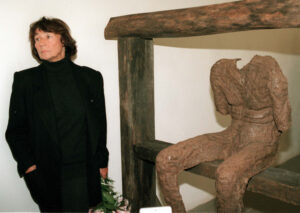
A breakthrough came in 1962, when at the International Textile Biennial in Lausanne, Abakanowicz presented “Composition of White Forms,” a work whose texture combined not only wool and linen but also sisal. Three years later, in 1965, her work won an award in São Paulo, confirming that what she was creating was no longer traditional craftsmanship but a new artistic language.
The primary subject of Magdalena Abakanowicz’s work was the human being, specifically its anatomy and life. A human is composed not only of soft tissue but also of bone. Strong structures that give it durability, yet are also fragile. From the 1970s onward, the artist clearly shifted toward harder, more austere materials, and her sculptures began to acquire a massiveness, roughness, and structural brutality.
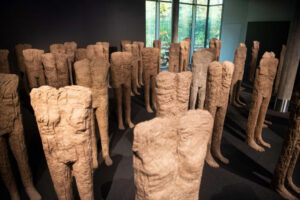
“The Backs” (1976–1980): eighty unique forms. Human torsos. Each different, yet all stripped of individuality. They form a crowd, yet are simultaneously solitary. Their proportions and textures vary, but they all take on a similar shape: the human figure reduced to pure physicality, faceless, and devoid of identity.
Several years later, in 1986–1987, Abakanowicz created another powerful series, “Crowd.” Standing figures, naked and defenseless. Vulnerable to manipulation. Subjected to oppression. These are not specific people, but rather a vision of humanity in a state of helplessness. Anonymous beings open to multiple interpretations: a subordinated person, a suppressed person, a person among many.
At the same time, Abakanowicz returned to organic themes with her “Embryology” series. Soft, egg-like forms, scattered across space. Irregular, varying in size, yet all similar. They lie as if abandoned, the remnants of something unborn or rejected. Symbolic, yet intensely physical. They were presented in the Polish pavilion at the Venice Biennale (1980).
In the late 1980s and early 1990s, another transformation took place. Material. Abakanowicz turned to metal alloys, including bronze. Her sculptures became heavier, harder, even more monumental. Bronze Crowd at the Sejm–1,000 cast figures. Metal, cold, but still devoid of individual features. Alongside bronze, she worked with wood, stone, clay, and sometimes ceramics. The material ceased to be merely a vehicle for form; it began to speak for itself.
The 1980s brought a growing interest in space. Sculpture was no longer a closed object. The space around it became a part of her work. Abakanowicz began working outdoors. In 1965, she exhibited her first spatial form in Elbląg. This project was followed by further monumental projects, including “Katarsis” (1985) in a sculpture park in Italy.
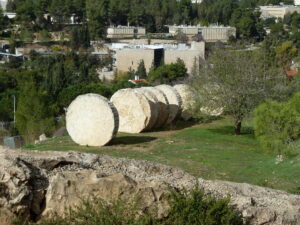
In 1987, came “Negev” for a museum in Jerusalem: seven enormous sandstone discs excavated from the desert of the same name. Placed on a hill, they blend into the landscape, yet at the same time serves as a sign of human presence. Monumental. Austere. Subject to the passage of time as much as humankind itself. The wheel–an invention that transformed civilization and a symbol of eternal return. “The Negev,” thus connects two worlds: that of nature and that of man.
The 1990s brought another direction, architecture. A project ahead of its time. Arboreal architecture, combining ecology with urban space. A contemporary trend? Perhaps. However, Abakanowicz had already been thinking about this in the 1990s. Her design for the Parisian district of La Défense envisioned covering buildings with vegetation and gradually blending the architecture into the landscape. The project was ultimately never realized, but from today’s perspective, it appears both visionary and prophetic.
“War Games” (1989). Trunks of old trees. Heavy, encircled by steel hoops. Like artifacts of a catastrophe. Like wrecks. Placed on metal bases and reminiscent of chariots of fire, war machines. The artist gave them symbolic titles: Baz, Ukon, Runa. Everything pointing to primal rituals, to ancient magic.
Duality. Ambivalence. Strength and fragility. Domination and helplessness. Power and subordination. Humanity in its two guises. On the one hand, powerful, capable of creating and destroying. On the other hand, defenseless, dependent on the world, on matter, on history. The artist reflected on the place of human beings within culture. Their role in history. Their capacity for survival and their susceptibility to destruction.
History, politics, war. All of these permeate her work. “The Cage” (1985), a symbol of enslavement and a direct reference to martial law in Poland. The figure is crouched, anonymous, enclosed in a wooden structure. It bears no individual characteristics. Anyone can see themselves in it.
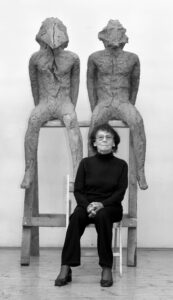
Magdalena Abakanowicz passed away on April 20, 2017, leaving behind an extraordinary artistic legacy. Her works bear witness to the 20th century, an era of war, political oppression, and social transformation. The human being, both as an individual and as part of a collective, always remained at the centre of her work. We are still as constituted as the day it was created. Thanks to her, art has changed forever.
Abakanowicz made a lasting impression on the global art scene. Her work transcends all boundaries, defying clear-cut classification. Many art historians and experts analyze her oeuvre, paying particular attention to the soft sculptural forms of the “Abakans,” which represented a breakthrough in the artistic language of the 20th century. However, toward the end of her life, Abakanowicz distanced herself from the “Abakans.” In interviews, she emphasized that she didn’t want to be perceived merely as a weaver; she wanted to be recognized as a sculptor.
Author: Nina Kucharczyk
Transation: Alicja Rose & Jessica Sirotin