Russian President Vladimir Putin frequently invokes history in an attempt to justify the war in Ukraine and other aggressive moves by the Kremlin. Recently, he has been repeatedly issuing threats aimed at the Baltic states, in response to which more and more countries are calling for mobilisation against them. Should the Kremlin’s warnings be taken seriously? And what do the Russians really mean when they invoke the idea of a Greater Russia? Professor Hieronim Grala, a former diplomat and researcher of the history of Rus’ and Russia, talks about this.
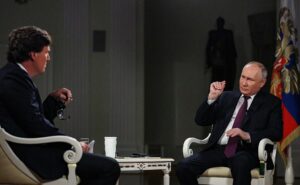
Michal Przeperski: In February 2024, Vladimir Putin met with the American journalist Tucker Carlson. They talked about various things – including, among other things, history. The interview resonated almost all over the world – including in Russia. Why did the meeting between the president and a foreign journalist grow into such an important event in Moscow?
Hieronim Grala: For several reasons. February 2024 marks two years since the Russian aggression against Ukraine. During this time, how many journalists – or, more broadly, people from the media world – have had the opportunity to receive the President of the Russian Federation at his home? Not many. Russia has faced international isolation. For Putin, this is something completely new and not entirely comfortable. For the last twenty years, he has been in the limelight – European and American journalists have reported on his movements, interviewed him, and he has followed it all with great interest. It added to his prestige. After 24 February 2022, all this came to an end. The world media still followed his every move closely, but they took his voice away from him. This somehow affected his ego as a great leader. It was also no small matter who conducted the interview.
Do the Russians have any special regard for Tucker Carlson?
They are looking at things more broadly. The US election campaign will very soon head into the homestretch. There will be a presidential election there in November, which will decide power in the only country that the Russians regard as a global empire. Yes, they recognise the power of China, but the point of reference in world politics for them is Washington rather than Beijing. Some of the Kremlin elite were therefore convinced that Putin was talking not so much to a former Fox News presenter, but to a potential vice-presidential candidate – as there was reportedly a strong possibility that he might run for election alongside Donald Trump. There was much, by the way, that the Kremlin elite did not get wrong – there were rumours from Carlson’s entourage that he treated the conversation with the Russian president as a means to gain him popularity and strengthen his position in Trump’s eyes.
Carlson had his interests in having this interview, Putin in giving it. It looks like theatre in which both sides played their parts. So should we even take this interview seriously?
This is precisely the crux of the problem. By arguing against Putin’s assertions – which are, of course, complete nonsense – and thinking about officially responding to them through the Foreign Ministry, we are somehow raising their profile. We create the impression that they are serious statements with solid arguments that can be debated. By doing so, we ennoble Putin’s ahistorical babble. A much better approach is taken by part of the Russian opposition or satirists who openly ridicule the talk, showing that it is impossible to take it seriously.
So are the Poles exaggerating? Are we taking Putin’s words too seriously?
Above all, we are looking at all this exclusively from our perspective, through the prism of the Polish historical experience. This is a point of view that is incomprehensible to a large part of Europe, especially Western Europe, and certainly to the United States. This problem has existed for centuries – Americans are unable to understand the European perspective. They look at our region and its history very differently from the Poles. Putin has not understood this either. With his story – which presents a painfully Eastern European point of view – he completely bored Carlson and deprived himself of the opportunity to reach a wide American audience. In the United States, no one will listen to Putin’s tirades about the history of Rus’ in the ninth century and about Rurik.
So what Putin has said is incomprehensible to Americans?
Definitely, you can see that from their reactions to this conversation. They believe that this type of narrative demonstrates a certain dysfunctionality of the ageing Putin. Insofar as they rightly refuse to give it credibility, it is further evidence that they do not understand how history is perceived on the other side of the pond – in Russia, but also in Poland.
On the one hand we have the Russian perception of history, on the other the American. Where in all this is there room for the Polish point of view?
We Poles make one major mistake in popularising our history abroad – we translate Polish historical studies into foreign languages and try to reach Western – or Eastern – readers with them. In most cases this does not work. Even if they were the most outstanding synopses or scholarly works, they will not work as well as studies by local historians who know the thinking of their compatriots. This is why even the most absurd historical ideas of Putin and his ideologues get through to Russians – because they know how to present them to the public.
Indeed, Vladimir Putin speaks about history very frequently and eagerly. Is he convincing to Russians in that regard? Do they really believe his slogans about a great Russia and the need to unite its territories?
In general, I would answer that they do. On the other hand, one important thing must be mentioned: Russians are an ageing society. A not inconsiderable proportion of them are Putin’s contemporaries or people brought up in the same educational model. From the 1940s to the late 1990s, there was an unchanging canon of history teaching in the Soviet Union. Putin uses concepts taken directly from it. Identifying historical Rus’ with modern Russia, he attributes to it the achievements of the Rurik dynasty’s state. In fact, he speaks the language of the greatest Russian historian of two centuries ago, Nikolai Karamzin, i.e. he goes back to the 19th century.
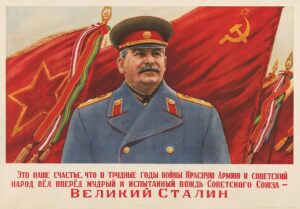
Harnessing history to the chariot of politics, he justifies Russia’s dominance in the region. Using slogans of historical necessity, he convinces Russians that he has a job to do – to reunite all the territories where the Rurik dynasty ruled. This is nothing new – this interpretation of the history of the Russian state was referred to by the Bolsheviks, Stalin – the very anthem of the Soviet Union spoke of a great Rus’. In a society fed by such slogans, there is a belief in Russian genius – and a historically justified right to dominate.
This interpretation of history has existed in Russia since at least the 19th century. Regardless of how the country’s fortunes have changed in that time, it has remained essentially intact. Is there, then, any space in Russia for a discussion with the only correct point of view? How should a professional historian respond to Putin ‘historian’?
First of all, there is no ‘Putin historian’. There is a collective quasi-historian, created on the back of the Russian president’s cabinet by dutiful – and unfortunately increasingly mediocre – historians from the circle of former Culture Minister Vladimir Medinsky and the Russian Military-Historical Society. At one time, Vladislav Surkov was active in Putin’s entourage – he was regarded as the chief strategist of the Russian government and probably also developed the basis of Russia’s policy towards Ukraine. Unlike many Kremlin people, he was a well-read, educated man, familiar with the work of forgotten Russian pre-revolutionary and émigré thinkers. Every now and then, therefore, he would reach for their works, extract ideas he needed and develop an interpretation from them, which he would provide to Putin. On this the Russian president based his historical narrative.
With Surkov gone, in his place came the intellectually rather mediocre Vyacheslav Volodin – the current chairman of the State Duma – and then a bunch of quasi-historians. Errors began to multiply at an alarming rate. One needs only look at the recent interview with Carlson Tucker. Putin said he was going to talk about history in a few seconds, then went on a 32-minute rambling rant about Polish colonisation in the 13th century, which was not and could not have been! Then he jumped to the 14th century. He got it all mixed up!
Surely this is also because he has no historical education whatsoever.
Of course. He repeatedly said that he had researched the subject himself, that he had read the sources in the archives – but this is nonsense. His version of history is very personalised – he doesn’t get into disputes about historical processes, about events from different centuries, because he gets it all confused. Instead, he has a number of characters that he uses as he pleases. When he wanted to project himself as a progressive ruler, he invoked Tsar Alexander II Romanov – who in the 19th century abolished serfdom and brought freedom to the peasants. At other times, he referred to the Russian prime ministers of the early 20th century: Sergei Witte and Pyotr Stolypin. The latter was even created by the Kremlin as a man of providence.
And what did the Russians think?
They did not believe it. In 2008. Putin organised a nationwide ‘Name of Russia’ competition – Russians were asked to vote for the historical figure they felt most symbolised their country. Despite Putin’s best efforts as a ‘moderniser’, for quite a while Joseph Stalin won – and by no small margin, beating the rest of the candidates by a head. In second place was Vladimir Lenin.
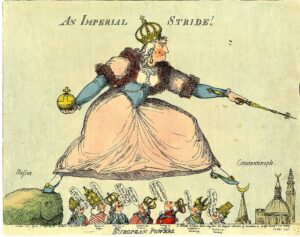
The president didn’t like this, of course, so he intervened – he organised a campaign that involved the ‘silver-tongued’ Kirill I, who was still a metropolitan bishop at the time, and the entire Orthodox Church. It worked, the medieval prince of Novgorod the Great and Prince of Vladimir Alexander Nevsky eventually won – at least officially. He then became a symbol of Eurasianism, due to his connivance – or rather unconditional collaboration – with the Orda. Putin quickly forgot about Nevsky, but returned to him in 2023. Again, he had a vested interest in it – he did so in order to scare the Baltic states supporting Ukraine. Slightly earlier, on the occasion of the annexation of four Ukrainian subjects, the Russian president in turn referred to Peter the Great – stating that he did not annex new lands to Russia, but reclaimed them. This echoes the tsar’s narrative – the latter also repeated that he had regained the Baltic territories, which were conquered by the ruler of Kyiv, Yaroslav the Wise, in the 11th century.
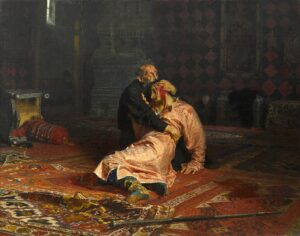
During his interview with Carlson Tucker, Putin also invoked Empress Catherine. So he has a collection of several historical figures to whom he refers. However, if I had to say who he really models himself on and who he is closest to, I would undoubtedly point to the one who is rarely mentioned officially – Tsar Ivan the Terrible.
In what sense is Putin closest to the 16th-century ruler?
In his perception of historical processes and laws. And in his attachment to the territory – not necessarily his own. At the same time, this is not an exclusively Putin’s approach. Vyacheslav Volodin – the chairman of the State Duma of the Russian Federation, once mentioned quite often as a potential successor to the current president – has said on numerous occasions that despite his considerable wealth, he has never sent his money abroad. When asked what he does with it, he replied that he buys land. In Russia, it is the most important thing.
In the 16th century, as part of the negotiations following the end of successive Polish-Russian struggles, Jagiellonian diplomacy offered to release Russian prisoners of war in exchange for border adjustments. A telling response was then received: ‘it is not fair to exchange what is eternal for what is temporal’, laced with the statement that once Russians are in captivity, they become as if dead to their own. In one of his letters, Ivan the Terrible wrote of the Baltic lands: “the hoof of my horse stood there, and so it is Russian land”. The actions of today’s Russian elites show that their thinking has not changed much. The way they understand historical processes resembles the mentality from the time of Ivan the Terrible.
Interviewed by Tucker Carlson, Putin asserted Poland did not interest him and that he would send his troops to Warsaw ‘only in one case: if Poland attacks Russia’. However, if one looks through the prism of Ivan the Terrible’s thinking, which is shared by the Russian elite, Russia did indeed have its troops in Poland – the last ones withdrew in 1993. So should we be concerned?
With Putin’s rule, every neighbour of Russia has more or less cause for concern. This is all for one reason – he makes his decisions based on the information he gets and in which he firmly believes. And these are carefully selected and presented to suit the Russian president. He took the decision to invade Ukraine after analysing specific studies and arguments – the few counter-arguments that were not to his liking were, of course, rejected. Putin’s entourage provided him with selective information presenting the picture he wanted to see. When he sent troops to Kyiv, he was convinced that they would break up major or minor demonstrations and that the resistance would end there. He did not think for a moment that there would be a war lasting several years. The fact that he has no idea what is going on – not only in Ukraine, but also in Russia itself – was also demonstrated by Yevgeny Prigozhin’s rebellion.
Putin lives in his information bubble and the risk is that we do not fully know what it is filled with. For this ignorance of the Russian president, we all may pay. Because at some point he may get information on the basis of which he thinks he can afford to attack another country. Why are more countries fortifying their borders? Why are the Scandinavians, so proud of their neutrality, pushing for NATO? Because they realise the threat. We cannot exclude the possibility that Putin will make some absurd decision.
So is there a risk that someday – like Ukraine – we may hear that Poland is basically not a state and has no right to exist?
Such slogans have already been uttered more than once in the Kremlin. On a number of occasions, Putin’s elites have referred to Poland and the Baltic states as ‘borderland creations’. Aleksandr Dugin – exaggeratedly referred to by many as ‘Putin’s philosopher’ – has more than once said that although he personally has nothing against Poland, there is no place for it between Russia and Germany. Because this is supposedly a ‘historical regularity’. Not everyone is so radical, of course; part of the Russian elite has a different opinion. Once, a Russian publicist, an excellent historian, published an article online in which he explained that among all Slavic nations, the Poles are the only interlocutor for the Russians because… ‘they have the gene of imperialism’ was the term used. Completely absurd, although the Russian wrote it with appreciation, stating that the Russians could share certain territories with the Poles.
The Russians would like to share Polish territory? Unbelievable.
Yes, most willingly Ukrainian and Belarusian. This author in question argued that the Grodno region ‘simply belongs to the Poles’. When the Russians remind us of the Polish roots of Lvov and Galicia, they do so not only as part of an information war to drive a wedge between Poland and Ukraine. They believe it themselves, at least some of them. And they are incapable of understanding that someone might not want to ‘reclaim’ their historic lands. Polish historians or publicists have more than once tried to explain the Polish point of view to the Russians. Suffice it to mention here Jerzy Giedroyc, who told them many times about Ukraine’s sovereignty, its right to self-determination. After all, he encountered fierce resistance on this issue among his allies – Russian dissidents – and his determination was of little use. The Russians have for years – for centuries! – have been thinking in terms of territorialising politics, in imperial terms. This is not just Putin’s view – it is shared by many Russians. His successor is likely to be too. And this is the greatest danger.
Interviewers: Michał Przeperski
Translation: Mikołaj Sekrecki