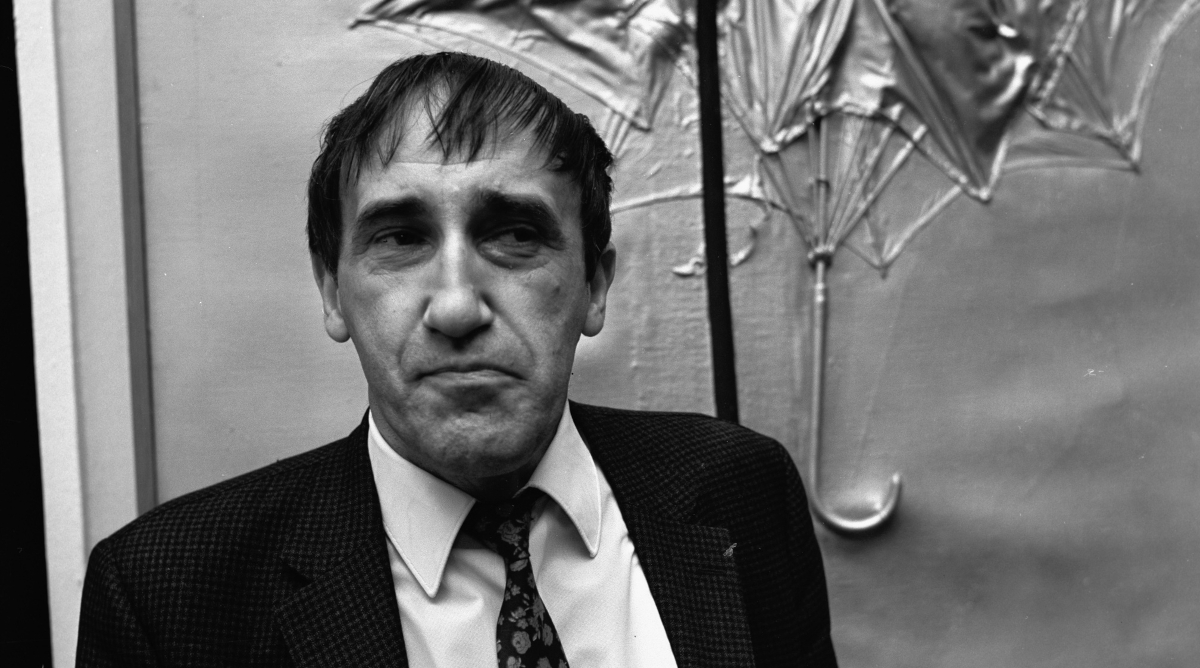
Tadeusz Kantor was a Polish multidisciplinary artist whose imagination transcended the confines of the canvas. His art surpassed painting to fully blossom on the theater stage. “The Dead Class” shocked audiences worldwide, and Kantor’s happenings constantly questioned the boundaries of art. From the humblest of materials – objects found in garbage dumps, mannequins, fragments of childhood memories – he created extraordinary assemblages. In the realities of the Polish People’s Republic, his theater became a haven of freedom, and Kantor himself emerged as a medium between the worlds of the living and the dead.
by Nina Kucharczyk
An Artist is Born
Kantor was born on April 6, 1915, in Wielopole Skrzyńskie, in the Podkarpacie region. He spent his childhood in a Catholic rectory, where he lived with his mother. His father, who returned after World War I, soon left the family and settled in Upper Silesia with another woman. This gap in his family history, the absence of a father, memories of war, and the atmosphere of a small town left a lasting mark on his imagination. Although Kantor was too young to consciously remember the marches of Austrian and Russian troops through Wielopole during World War I, the images of soldiers, deserted houses, and frontline unrest, gleaned from family stories and physical traces in the landscape, became the founding myth of his work.
In later statements, Kantor recounted these events in detail: “I remember their uniforms as if it were yesterday,” transforming the collective memory of the place into a personal mythology that came to life in “The Dead Class” and “Wielopole, Wielopole.”

During the interwar period, Kantor graduated from high school in Tarnów and went on to study at the Academy of Fine Arts in Kraków, where he studied under Karol Frycz and was strongly influenced by the work of Stanisław Wyspiański. Even at this stage, he was developing a unique style that combined expressionism with symbolism, which later developed into works notable for their intensity of form and depth of metaphor. His paintings stood out for their sensual materiality, unsettling atmosphere, and ability to connect everyday objects with spiritual dimensions. During World War II, Kantor worked as a house painter in Kraków.
In December 1939, he managed to complete his final exams at the Academy of Fine Arts, but as the conflict escalated, he was forced to hide near his hometown of Wielopole. It was during this time that he began creating his independent theatre. During the occupation, he founded the Underground Independent Theatre, staging clandestine productions of Juliusz Słowacki’s “Balladyna” and Stanisław Wyspiański’s “The Return of Odysseus.” Rehearsals were held in secrecy at the home of his first wife, Ewa Jurkiewicz, and the early performances had a distinctly patriotic character.
Against Socialist Realism
Immediately after the war, Kantor co-founded the Young Artists Group, and during the political thaw of 1956, he helped revive the pre-war Krakow Group. He also initiated the Krzysztofory Gallery, one of the first post-war spaces showcasing contemporary art. In 1947, Kantor traveled to Paris. Participating in the International Exhibition of Contemporary Art at the Musée d’Art Moderne offered him a new perspective. Upon his return to Poland, he entered an extraordinarily prolific period in his life: painting, creating, and organizing intensively. In 1948, he initiated the Exhibition of Polish Modern Art at the Palace of Arts in Krakow, which became one of the most important artistic events of post-war Poland. During this period, Kantor was appointed professor of painting at the Higher School of Fine Arts in Krakow. Just a year later, however, with the introduction of Socialist Realism as the “only progressive creative method,” he was stripped of his professorship. From 1950 to 1954, Kantor deliberately withdrew from official artistic life in protest against the imposed doctrine of socialist realism.
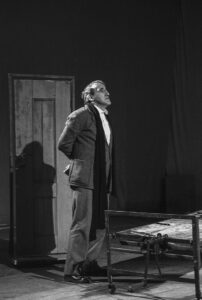
In 1955, Kantor founded the Cricot 2 Theatre. Its very name, evoking a circus, underscored the absurd dimension of his art. Cricot 2 became a space where the worlds of the living and the dead intertwined, and each performance was a kind of ritual. “An artist must be like a shaman – a mediator between the worlds of the living and the dead,” he said.
He drew inspiration from Jewish culture, especially Hasidic mysticism. His performances abandoned linear plots; they resembled hypnotic dreams. Kantor used to say: “Art must kill reality in order to save it.”
Tadeusz Kantor transcended the boundaries of traditional theater, pioneering a new form – the happening. In 1967, he staged “Sea Happening,” where an audience on a beach witnessed a symbolic drowning – a subtle yet sharp critique of the system. That same year, in the happening “Letter,” he set fire to his own works, questioning the meaning and value of art in a world subjugated to ideologies and the market. Although he didn’t engage directly in politics, his theater was a form of resistance. “In Poland, even death isn’t taken seriously,” he said. The characters in his productions resembled war victims, and the artist himself admitted that he could measure a performance’s success by reading the expressions of the censors. Before the theater completely consumed him, Kantor was a leading figure in Polish Surrealism and Informel. His “Anti-Exhibition” from 1957 became a landmark in the history of contemporary art in Poland.
“I’m like an old piece of furniture – I’m full of drawers, and in each of them something moves,” Kantor said of his studio in Krakow’s Mały Rynek (Little Market Square). This space, both his home and his creative laboratory, had a double life: at night it bustled with intense work, while in the mornings it became a rehearsal space.
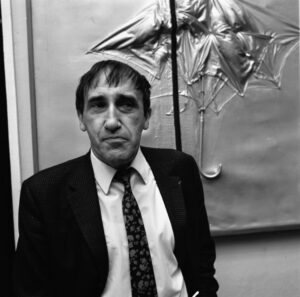
When others began their work, he would finally rest after a night spent creating. Yet, morning rehearsals were sacred. Always punctual, he arrived in his trademark black coat, which almost seemed like an artist’s uniform. His meticulous attention to detail was evident everywhere, from the arrangement of props to the precise instructions he gave the actors.
The studio also witnessed Kantor’s final days. On December 8, 1990, the day before his death, while preparing the performance “Today Is My Birthday,” he maintained his ritual and his nocturnal reflections, which he brought to the stage in the morning. His final resting place at the Rakowicki Cemetery in Krakow is a unique installation – a cross with an umbrella, now a lasting symbol of his art.
Everyday Life and Metaphysics
“If I weren’t an artist, I would be a grave digger,” he joked, but this statement embodied his philosophy. For Kantor, art was meant to extract life from beneath the layers of death and oblivion.
Today, Kantor’s work stands as one of the most important reference points for 20th-century theater. He has been compared to Samuel Beckett, Jerzy Grotowski, and Joseph Beuys. But in truth, Kantor created a language all of his own. “The Dead Class” went down in history as a play that transformed the world stage when it premiered on Broadway in 1979. It won the admiration of New York critics, and it continues to be cited in theater textbooks alongside “Waiting for Godot.”
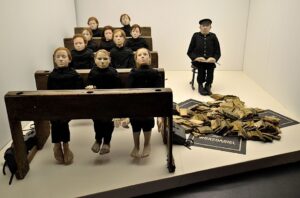
Kantor’s radical approach to art, which combines the everyday with the metaphysical, has shaped generations of artists. He proved that from the simplest of things – an old chair, a suitcase, a mannequin – it was possible to create a universal language of memory. His theater was never merely a performance; it was a ritual of reclaiming the past. Museums in Tokyo, New York, Berlin, and Paris continue to stage exhibitions of his work. The Cricoteka in Krakow has become a palimpsest where his spirit – literally and metaphorically – lingers between the set and the archives. In Poland and around the world, young artists still draw on his vision of a “theater of death,” while his notes and drawings are read as manifestos of the new avant-garde.
“Black is the color of transcendence,” Kantor often said, emphasizing that it was not merely a color, but also a symbol of transition, mystery, and infinity. For him, black was the space where life and death, memory and oblivion, matter and spirit converged. And indeed, what Kantor left behind was not only performances or paintings, but above all a new way of seeing art. He saw art as an act of preserving what is fleeting, an attempt to capture and hold a moment between worlds. This vision of art is why his work remains alive – constantly resonating in the consciousness of audiences and artists alike, as if continuing in another, never-ending happening that haunts human memory and existence.
Author: Nina Kucharczyk
Transation: Alicja Rose & Jessica Sirotin