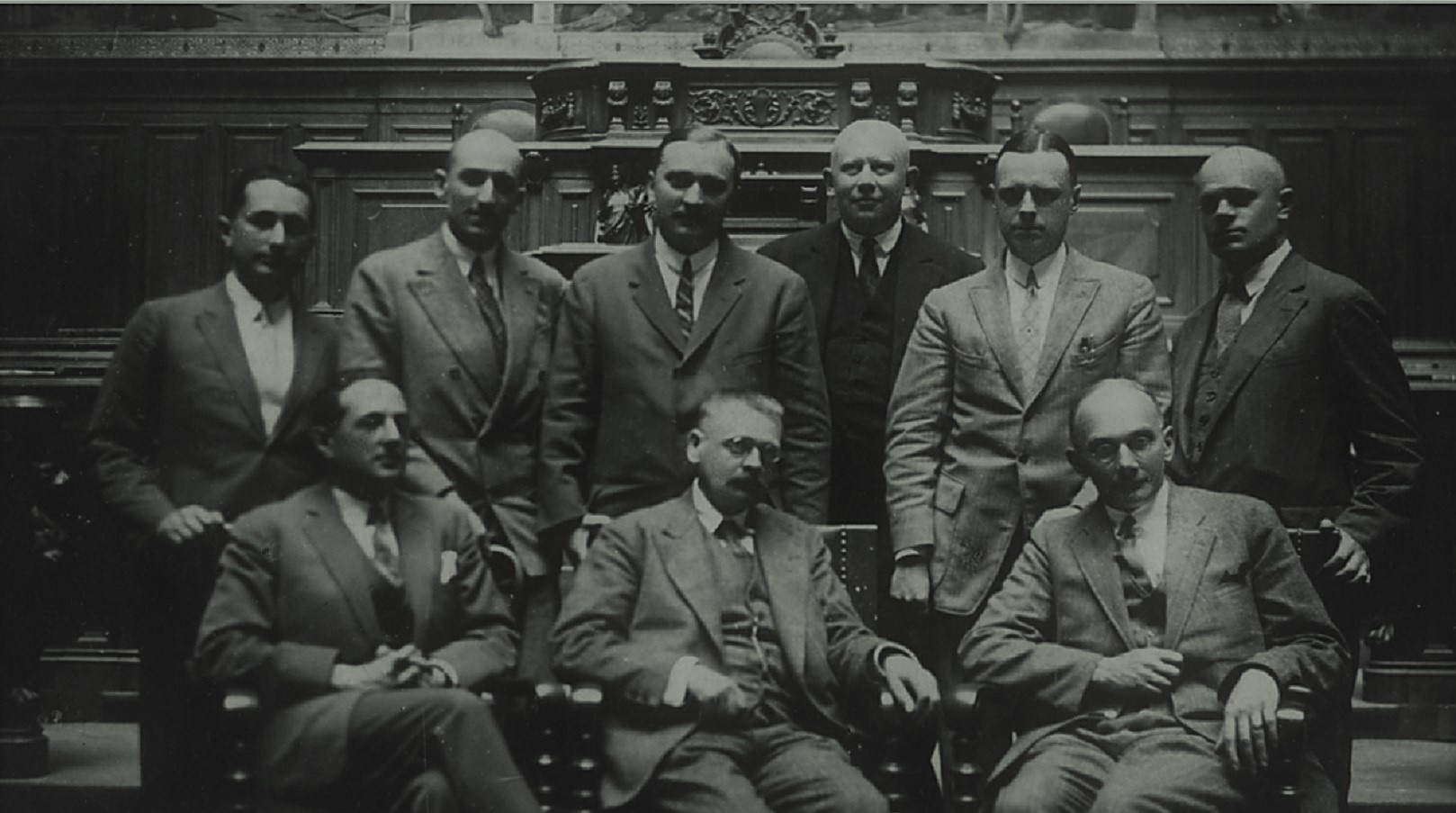

Three-time prime minister and leader of the peasant movement, Wincenty Witos was one of the most distinguished statesmen of the Second Polish Republic. Born into a poor peasant family, he rose to the heights of power through his own hard work and determination, never losing touch with his origins. Witos earned a place in Polish history as a man of the people who, at crucial moments, was able to unite his compatriots across divisions. He is still remembered today as one of the ‘fathers’ of independent Poland – a man who contributed significantly to the rebirth of the state and the shaping of its democratic foundations.
by Grzegorz Barański
From a Galician village to parliament
Wincenty Witos was born on 21 January 1874, in the village of Wierzchosławice near Tarnów, in the Austrian partition. He came from a very poor peasant family – his parents farmed just over a hectare of land, and the family home was a wooden hut converted from a barn. From childhood, he experienced hard work and privation, completing only a few grades of school. He continued to study independently, read widely, and published his first articles as a teenager.
At the age of 18, he became involved in the peasant movement, joining the nascent People’s Party. His activism, charisma, and oratory talent quickly earned him the respect of the local community. Witos was involved in local government, serving for many years as mayor of his native village, as well as in the regional politics of Galicia (the part of Poland annexed to the Austrian Empire during the partitions). In 1908, he became a member of the Galician National Sejm in Lwów, and from 1911 he also served in the Vienna parliament as a representative of the peasants. Already at that time, he established himself as a staunch advocate for rural development and a skilled speaker. In 1914, following a split in the peasant movement, Witos co-founded the new Polish People’s Party ‘Piast’, and assumed its leadership, remaining in this position until 1931.
The fight for independence
World War I placed Witos on the frontlines of the battle for Polish independence. Initially, he was active in the legal political structures of Galicia (including the Supreme National Committee supporting Józef Piłsudski’s Polish Legions), but as the war progressed, he became increasingly involved in efforts to regain sovereignty. He maintained contacts with activists of various independence movements, aware that the rebirth of Poland required the unity of all patriotic forces.
In October 1918, as the Habsburg Empire was nearing collapse, Witos became head of the Polish Liquidation Commission in Krakow, a temporary Polish government for Galicia which took over from the crumbling partitioning administration. Led by Witos, the Liquidation Commission announced the annexation of Małopolska to the resurgent Polish state, and ensured a relative degree of order until a national government could be established. Witos thus contributed significantly to Poland’s return to the map of Europe as an independent nation in November 1918.
Prime minister of the Government of National Defence
Witos’s greatest hour of trial came in 1920. Newly reborn Poland faced a mortal threat: the invasion of the Bolshevik Red Army, which intended to ‘carry the fire of revolution’ further into western Europe. In July of 1920, the situation at the front was critical: the communists were approaching Warsaw, and panic was growing in the country. Under these circumstances, the mission of establishing a Government of National Defence was entrusted to Witos – a peasant activist who enjoyed the trust of the peasant masses – the clear majority of society. It is said that a government messenger found Witos ploughing a field – he was literally ‘called away from the plough’ to save the Fatherland (a reference to the legend of the Roman consul Cincinnatus).
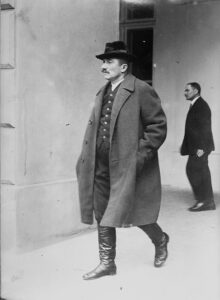
Witos did not hesitate for a moment. On 24 July 1920, he assumed the position of prime minister, leading a non-partisan government of national unity at the most difficult moment of the war. As prime minister, he immediately appealed to all citizens to stand en masse in defence of the country. In a message to the rural population, he wrote passionately: ‘All those among you capable of bearing arms – to the front! Today, the highest duty of every Pole is to serve in defence of the Fatherland!’. These words were not left unanswered. Hundreds of thousands of peasants followed this call, abandoning their ploughs and taking up arms against the invader. At that dramatic time, Witos’s government, seeking to win over the peasants, also promised to fulfil their long-standing demands – a law was passed announcing an agrarian reform which promised the division of large landed estates.
Thanks to the mobilisation of the entire nation, Poland managed to halt the onslaught from the east. In August 1920, the Battle of Warsaw took place, in which Polish forces defeated the Red Army, preserving the country’s independence. This triumph not only determined the fate of Poland but also prevented the spread of the Bolshevik revolution into Central Europe. As head of the Government of National Defence, Witos played a crucial role in this victory: he was able to rise above party disputes, unite various factions, and infuse the spirit of patriotism into the rural masses, without whose sacrifices success would not have been possible. This was the pinnacle of his political career. He fulfilled his mission of transforming Polish peasants into conscious citizens willing to sacrifice their lives for their country.
At the helm of a young state
Following the defeat of the Bolsheviks, Witos continued his mission of state-building until September 1921. As prime minister, he contributed, inter alia, to the adoption of a democratic constitution in March of 1921, laying down the foundations for the political system of the Second Polish Republic. Witos served as prime minister twice more: in 1923 and briefly in May 1926. His second government – based on a coalition of the Polish People’s Party ‘Piast’ and the Christian Union of National Unity (known as ‘Chjeno-Piast’) – struggled with a severe economic crisis in young Poland. Despite their willingness to conduct reforms, Witos’s cabinet was forced to resign after several months when the economic situation spiralled out of control.
Witos’s third term as prime minister came in May 1926, during another political crisis. It was a dramatic episode – just days after the appointment of this cabinet, Marshal Józef Piłsudski launched an armed coup. In order to avoid bloodshed, Witos, in consultation with President Stanisław Wojciechowski, resigned, paving the way for Marshal Józef Piłsudski’s personal rule.
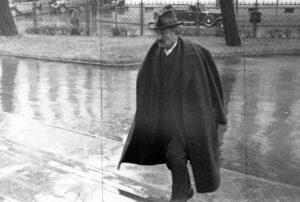
Despite holding the highest offices, Witos remained true to himself – even as prime minister, he dressed like a peasant (high boots, no tie). Some of the Warsaw elite mocked his unsophisticated attire, calling him a ‘peasant without a tie’. Representatives of the people often reacted in just the opposite way: they were proud that their representative was not ashamed of his peasant origins.
Emigrant, prisoner, symbol
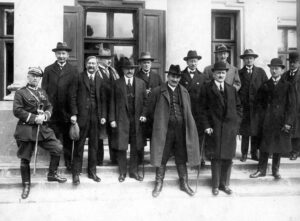
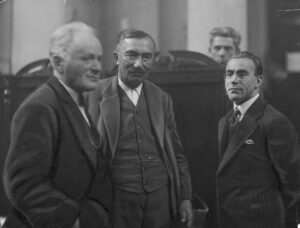
Following the May coup, Witos did not withdraw from public life – to the contrary, he led the opposition against the Sanation government. In 1929, he co-founded Centrolew, a bloc of opposition parties demanding the restoration of full democracy and the rule of law in the country. However, the authorities decided to silence Centrolew’s leaders by force. In September 1930, just before the elections, Witos and several other opposition leaders were arrested and imprisoned in Brest-on-the-Bug. During a show trial in 1931, Witos uttered the famous words: ‘The power of the state and its future cannot be secured by any genius, even the greatest – only a whole, free nation, aware of its rights and obligations, can do so’. The court sentenced him to eighteen months in prison, which was widely understood as repression for his political independence and criticism of Piłsudski’s government. To avoid imprisonment, Witos fled to Czechoslovakia in 1933, where he was granted political asylum.
Six years spent in exile did not break Wincenty Witos’s spirit. He settled in Prague, although his heart and thoughts remained in Poland. He continued to lead the peasant movement from abroad through trusted associates. Witos became a legend among the Polish rural population, and his name a symbol of the fight for human rights and democracy. When the outbreak of World War II became inevitable, Witos decided to come home. In the summer of 1939, sensing the impending historical storm, he returned to Poland.
For Witos, the outbreak of World War II was a tragedy. His efforts to build an independent Poland were shattered, and he once again found himself at the mercy of hostile powers. For the occupiers, Witos was an inconvenient figure – a living symbol of resistance. The Germans attempted to persuade him to collaborate, tempting him with the creation of a puppet ‘peasant government’. Witos categorically refused. In retaliation, he was placed under strict Gestapo surveillance in his home village. In 1945, in Soviet-occupied Poland, Witos fell into the hands of the NKVD. The communists also sought to exploit his authority, persuading him to join the Moscow-controlled pseudo-parliament (known as the State National Council) and nominally co-chair the reborn Polish People’s Party. This was a purely symbolic move. Seriously ill, Witos was no longer able to truly participate in politics.
Legacy
Wincenty Witos died on 31 October 1945 in Krakow. His funeral became a grand demonstration of remembrance and gratitude. A funeral procession carried Witos’s coffin on foot from Krakow to Wierzchosławice, joined along the way by throngs of residents from the towns through which it passed. Crowds of peasants, for whom he was a hero and leader, accompanied him on his final journey. He was buried in a cemetery in his native land.
Wincenty Witos’s historical contributions cannot be overstated. As a leader of the peasant movement, he taught Polish peasants pride in being citizens of an independent country. It was he who ‘brought the peasants to Poland’, making the largest group of the nation feel co-responsible for the state. Witos believed in democracy and human rights, but also understood the importance of civic duty. He consistently rejected the idea of revolution – he desired to achieve social change gradually and legally, warning that violence only breeds new tyranny.
He was a proponent of parliamentary democracy and the rule of law, in which a strong government is combined with oversight by a parliament elected by the people. He emphasised patriotism based on daily honest work and dedication to the common good. His refusal to collaborate with the Nazis and his steadfast stance during the Brest trial demonstrates his unquestionable devotion to values such as independence and honour. After many decades, the Polish state also cleared Witos’s good name – in 2023, the Supreme Court invalidated the verdicts of the Brest trial, rehabilitating him and the other convicts and restoring justice.
Witos’s influence extended beyond Poland’s borders. During the interwar period, he was one of the most prominent peasant politicians in Central Europe. Under his leadership, Poland was among the pillars of the ‘Green International’ – an international agrarian movement opposing both communism and fascism. Owing to such leaders, Central Europe maintained a certain balance in the 1920s – the voices of millions of peasants were heard, limiting the scope of action for extreme ideologies.
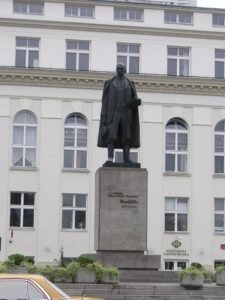
Wincenty Witos holds a special place in the pantheon of Polish national heroes. As a leader of peasant origins who became a statesman, he symbolised the rise of millions of ordinary Poles to the ranks of full-fledged stewards of their own country. His life is proof that patriotism is not reserved for the elite – that the son of a poor peasant can contribute to history if he possesses courage, passion, and a sense of duty. Witos influenced the fate of Poland, contributing significantly to its rebirth and survival in the turbulent 20th century. The year 2024 – the 150th anniversary of his birth – was declared the Year of Wincenty Witos in Poland. Monuments honouring him stand in many Polish towns and villages, and schools, squares, and streets bear his name.
Author: Grzegorz Barański
Translation: Katarzyna Jopek