Three Kings Day, commonly known as the Epiphany, is one of the oldest Christian holidays. Celebrated on 6 January, it symbolizes the revelation of God in the form of Christ born in Bethlehem. In current times, a holy mass is celebrated in churches on this day, and colorful processions featuring the Three Magi wind through the streets of Polish towns and villages. Years ago, in the Republic of Poland, the Feast of the Epiphany was celebrated in a slightly different way.
by Anna Wójciuk
The symbolism of the Epiphany in the Christian tradition
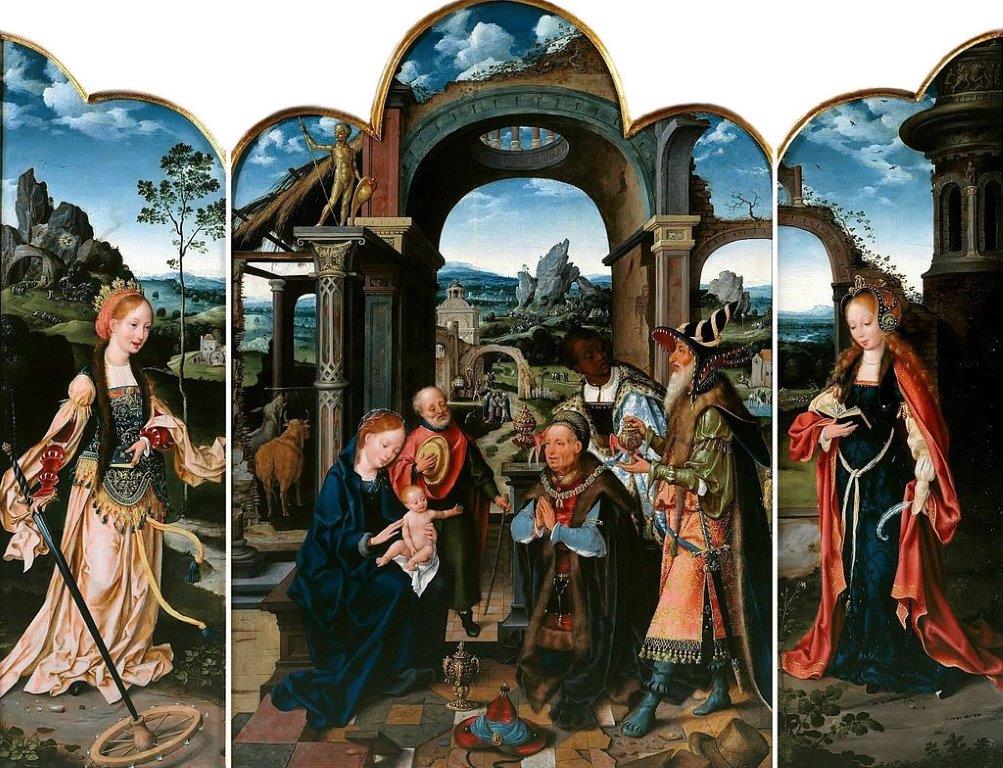
The Epiphany is one of the first feasts established by the Catholic Church and has been celebrated since the 3rd century. The Epiphany ends the cycle of religious celebrations related to the birth of Christ and begins the season of Carnival. According to the Christian tradition [surrounding the Epiphany], Three Wise Men from the East named Casper, Melchior, and Balthazar followed the glow of the Star of Bethlehem to the birthplace of Jesus. They paid him homage, acknowledged his divine nature, and gave him gifts of gold, myrrh, and frankincense.
Each gift carries a symbolic meaning: gold is a sign of royalty, myrrh is a symbol of the fulfillment of messianic prophecies and the foreshadowing of the martyrdom of Jesus on the cross, and frankincense symbolizes his divinity. The adoration and gifts are at the same time an expression of faith in Christ as a true [mortal] man (myrrh), the one true God (frankincense ) and a true king (gold).
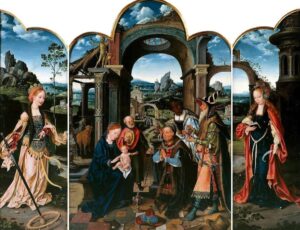
In Poland’s first centuries of Christianity, the Epiphany was celebrated with Christmas. This way, 6 January became a more significant celebration of the Revelation of God. This tradition has been preserved to this day by Christians of the Eastern Rite, i.e., Orthodox and Greek Catholics. [In the Western Church,] the tradition to celebrate Christmas and the Epiphany as two separate holidays, on 25 December and 6 January, began in the second half of the 4th century.
Epiphany Eve in Old Polish times
In the past, on the day before the Epiphany, a fire would be laid in the fireplace. Then on the day of the Epiphany, candles would be lit by the priest during the mass. Once the fire had been lit, no other kind of fire was to be brought into the house. According to popular belief of the time, misfortune would follow if other fires were brought in, and the farm would be in danger of catching fire.
On the eve of the Epiphany, young brides would visit houses where potential suitors lived. These visits were expected, and the girls were gladly received and cordially hosted. After a day filled with visits, residents of the villages and towns would meet in one place to celebrate the upcoming Solemnity of the Epiphany.
The Epiphany in old Poland
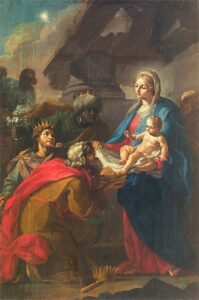
On the day of the Epiphany, everyone was required to attend mass. During the mass, the priest placed objects brought by the faithful on the altar, symbolizing the gifts that Jesus received from the Three Wise Men from the East. These were usually rings, medallions, and ducats. Next to it on the altar would be myrrh, made from spruce resin or juniper berries, and frankincense. In addition to gold, myrrh, frankincense, and chalk, the clergy would also bless water to commemorate the baptism in the River Jordan. Burning consecrated incense in the house and farm buildings was believed to protect against misfortune and disease. The incense remains were then wrapped in white linen for the whole year. The consecrated gold was supposed to protect the household against evil and ensure fertility and prosperity. The myrrh would be used medicinally, and the chalk would be used to undo evil spells. In addition, the priests would pour holy water into the well to make the water in it tasty and healthy.
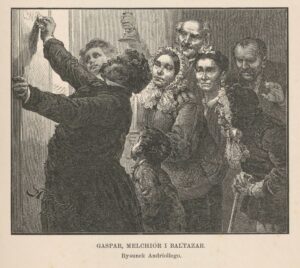
On 6 January, the parish carol celebration would begin: the clergy (often together with altar boys, organists, and churchmen) would visit the faithful of their parish. After praying together, singing Christmas carols, and conversing, they would inscribe the doors with the first letters of each of the Wise Men’s names separated by the sign of the cross. The acronym K + M + B (or in Latin C + M + B) stands for the Latin phrase “Christus Mansionem Benedicat” (May Christ bless this house). After the clergyman left the house, the maidens would rush to sit on the chair he had occupied, as it foreshadowed a quick marriage. The master of the house would also draw a cross on the farm buildings’ doors and livestock’s horns and foreheads. In the past, it was believed that the consecrated chalk protected the household, its members and the animals from impure forces. Some would even draw a protective circle around the entire farm.
Generous Day
In Old Polish times, the Epiphany was called the Generous Day. First, housewives baked ritual bread, which they gave to the carol singers, among whom there would be boys and/or men dressed as the Three Wise Men. Then, wearing ceremonial robes and cardboard crowns, they would sing hymns about the Divine Revelation. The society of that time was famous for its generosity, hospitality, and religiosity, so the carol singers were eagerly welcomed in old Polish manors and houses. They received sumptuous refreshments and money in exchange for their visit and good wishes.
In general, gift exchanges were a common custom on the day of the Epiphany, although it was symbolic. Giving gifts to relatives, friends, neighbors, or court servants was common to commemorate the gifts of the Three Wise Men. Thus the king and the magnates gave presents to courtiers, and the nobility gave them to their servants as a sign of respect and gratitude for their daily work. In all the mansions and houses, red apples and nuts were given to the children to ensure their health and strong teeth. In short, almost every believer tried to give someone a gift on this day.
In the Old Polish times, the “Almond King” game was popular among the wealthiest social classes, but it was only played on the Epiphany. This game consisted of hiding a sweet almond in a cake, gingerbread, or a cone filled with sweets. The men would then select their pieces first. Whoever was lucky enough to find an almond became the “almond king.” Then, the “almond queen” was chosen in the same way. The Old Polish “almond royal couple” received awards, occupied a place of honor at the banquet table, were granted the right to rule throughout Carnival, and enjoyed special favors during carnival games. For example, deciding on the types of social games and their rules.
The Feast of the Three Wise Men, then, and now
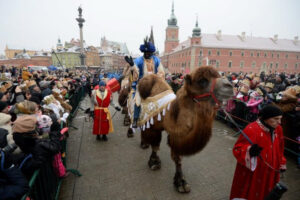
The Epiphany was celebrated in the church and in homes in Old Polish times. After a long and joint celebration, the guests would return to their homes, and the hosts once again took up their daily duties. The ceremonial processions of the Three Kings, so popular today, did not occur. Speaking of the Epiphany, it is worth noting that it disappeared from the holiday calendar for a certain length of time. 6 January in Poland was a holy day and a statutory holiday until 1960, when the then-communist authorities removed it from the official calendar of religious and national holidays. At that time, all celebrations of this holiday were also forbidden.
The Epiphany returned to the holiday calendar in 2011, according to a law passed by the Polish parliament on 24 September 2010. In churches, in memory of the homage paid to Jesus by the Three Wise Men, during the mass, the clergy bless incense and pieces of chalk, with which the faithful write the acronym K + M + B on their doors (along with the date of the current year). Many Polish towns and villages have colorful parades and retinues of the Three Kings — an excellent start to Carnival!
Author: Dr Anna Wójciuk
Translation: Alicja Rose & Jessica Sirotin