The attack on Westerplatte was one of the first acts of armed German aggression against Poland in September 1939. The heroic defence of the peninsula has gone down in history. It was assumed that the resistance would last a few hours. Meanwhile, the Polish garrison defended itself for seven long days…
by Daniel Czerwiński
Western island
The present mouth of the Vistula is a manmade channel. In the past, the river flowed into the sea at Gdańsk. Regularly deposited sediments caused the river and sea currents to create numerous shoals and islands, and consequently two islands: the eastern Ost Platte (which merged in time with the mainland) and the western West Platte (hence the name Westerplatte). On two occasions it became the scene of bloody battles. In 1734, French troops supporting King Stanisław Leszczyński fought there against the Russians. The second time Westerplatte became the scene of events of international importance was during the Napoleonic Wars.
In 1840, as the result of an ice dam, the Vistula broke a section of the coastal dune and created a new mouth for itself: the Wisła Śmiała (Bold Vistula). This caused the former estuary at Gdańsk (named the Martwa Wisła [Dead Vistula]) to lose its importance, and it was covered up between 1845 and 1847, thus creating a peninsula. By then it was already being used as a leisure area. The intense development of Westerplatte took place in the last two decades of the 19th century, at which time its appearance and character changed fundamentally. The hitherto small bathing resort of local importance was transformed into a well-known resort and spa.

Exclave in the Free City
Germany’s defeat in the First World War changed everything. The victorious powers decided to make Gdańsk a Free City. This compromise did not satisfy either side and immediately became a source of contention. For the Poles, it was the only available port on the Baltic Sea. The Germans, meanwhile, regarded Pomerania as German territory and had no intention of giving it up. The subsequent course of events only confirmed this. When, in 1920, recovering Poland was fighting the Bolshevik invasion, German dockers deliberately blocked shipments of arms and ammunition for the Polish army in the port of Gdańsk. To ensure that they could control a section of the Gdańsk harbour, a Polish exclave had to be created. Although the Second Polish Republic was to build a port in Gdynia, these were just plans at the time.
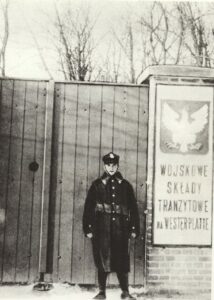
It was under such circumstances that the Military Transit Depot at Westerplatte was established. The Poles had already bought up part of the land on the peninsula. Mieczysław Jałowiecki, who at the time held the post of general delegate of the Ministry of Provisions for the city of Gdańsk, played a major role in this process. The Gdańsk authorities, however, did not want to agree to the creation of a separate area. After many disputes, by decision of the Council of the League of Nations, the Westerplatte peninsula was handed over to Poland as a base for reloading weapons and ammunition. From 1924, construction work began there, and on 18 January 1926, at 2.00 p.m., the first detachment under the command of Lt Stefan Konieczny arrived on the minehunter ORP ‘Mewa’. It consisted of two officers, four NCOs and 16 privates. It commenced guard duty two days later.
Expansion of potential
With the granting of land for a war material depot, Poland was given the right to establish a uniformed and armed guard there. Its task was: ‘to protect the military ammunition deposits in the area of the Depot, to protect the loading and unloading of military cargo in the Ammunition Basin, and to guard the area of the Depot itself’. Poland requested 114 soldiers in the area. Calculations by the Council of the League of Nations indicated that there could only be 88.
Construction work on the peninsula had been underway since 1924. The construction of the Ammunition Depot was completed in November 1925. Six harbour cranes were erected along the quays. In the summer of 1925, the railway line leading to the depot was completed. Warehouses were also built. After the area was taken over by the Polish authorities, a railway station, a power station and a telephone line connected to the Polish Post Office were built. The depot area on the side of the harbour channel was enclosed by a 2 m high brick wall and the rest by a barbed wire fence.
However, fortifications were still lacking. They could not be built officially, so the Polish side had to do this in secret. Between 1933 and 1934, five guardhouses (secretly additionally fortified and armed) were erected at Westerplatte, while modern barracks were constructed between 1934 and 1936. Shortly before the outbreak of war, an additional system of outposts was created in front of the guardhouses – including defence sites with such names as ‘Ferry’, ‘Embankment’, ‘Fort’, ‘Baths’, ‘Power Station’, and ‘Marina’. At the same time, the number of soldiers was secretly increased. Studies provide different numbers of those fighting at Westerplatte ranging from 164 to 215. The problem is that the final personal orders have not survived. According to the most recent calculations, 201 soldiers and seven civilian staff were stationed on the peninsula on 1 September 1939.
They had at their disposal largely clandestinely transported armaments in the form of Mauser rifles, about 40 heavy and hand-held machine guns, two 37mm calibre anti-tank guns, a 75mm calibre field cannon wz. 1902/26, and four 81mm calibre mortars. The depot’s commandant from 1938 was Major Henryk Sucharski, and his deputy Captain Franciszek Dąbrowski.
Courteous visit
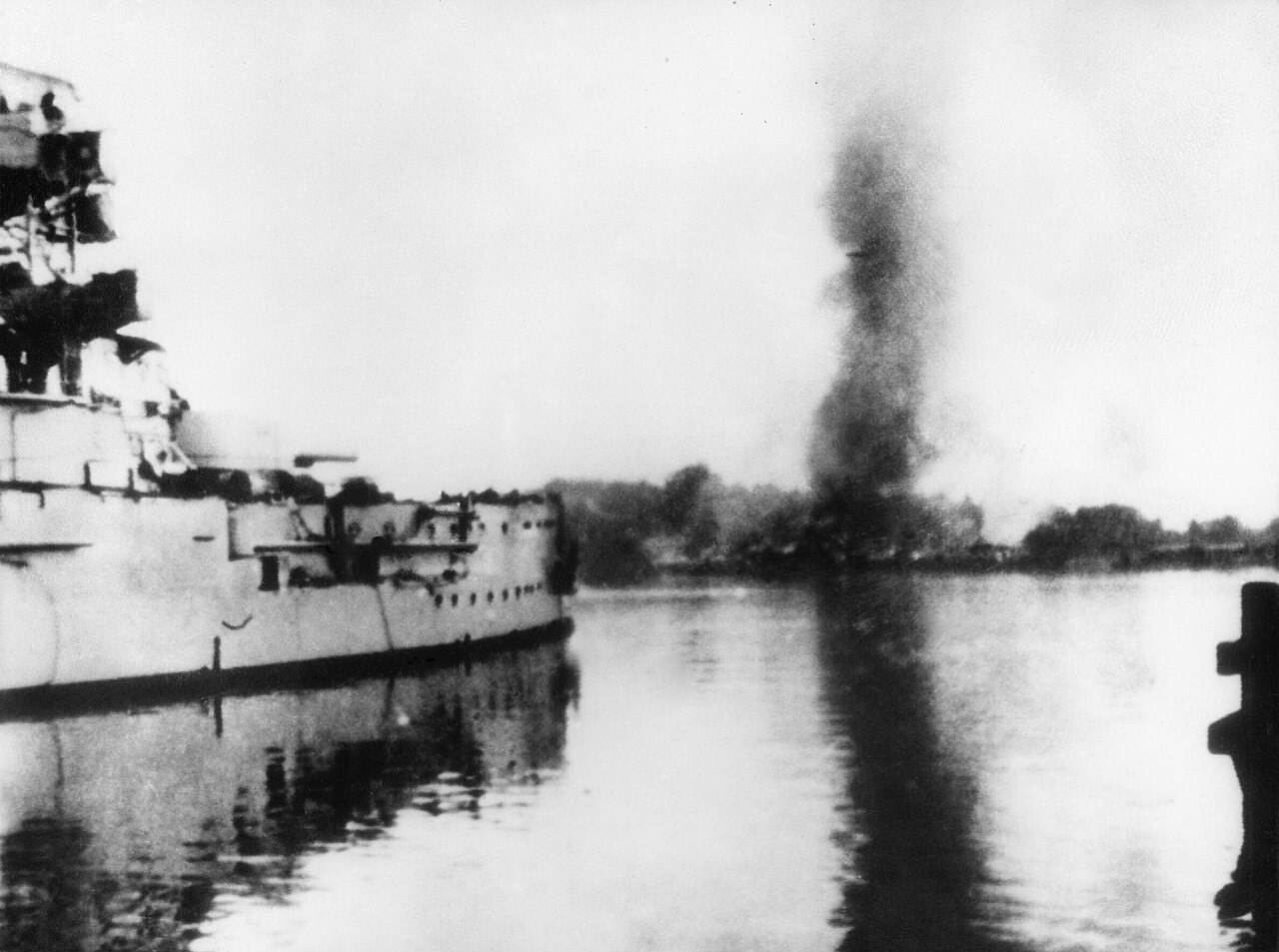
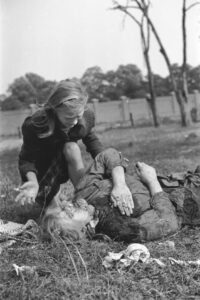
The policy of the Third Reich in the 1930s had to lead to war. This happened in 1939, and one of the first (if not the first) shots of the war was fired at Westerplatte by the German battleship Schleswig-Holstein, which called at the port of Gdańsk on 25 August for a ‘courtesy’ visit. In reality, it was to attack Polish soldiers the very next day. This did not happen only because Adolf Hitler postponed the date of the attack to 1 September. The ship was moored about 150 m from the Polish depot. On the night of 31 August to 1 September, however, it was towed to Five Whistles Bend, from where it had a better field of fire. On the same night, a Kriegsmarine assault company came ashore, tasked with seizing the peninsula. Units of the Gdańsk police and the local SS were also assigned to the attack. It is difficult to determine their numbers unequivocally. Estimates range from just over 500 to more than three thousand.
Schleswig-Holstein was a rather old unit, but with powerful firepower. Its main guns were 280mm calibre (although it must be admitted that it stood too close to take full advantage of them). According to orders, it was supposed to open fire at 4.45 a.m., but this in fact happened three minutes later. With the start of the cannonade, the railway gate and the previously mined sections of the wall were blown up. The Germans did not expect a Polish reaction. It turned out, however, that those defending the Ferry outpost were able to repel the attack. The Poles used the most powerful weapon they had, a 75mm cannon. The first attack was repulsed.
The next assault was preceded by a prolonged artillery preparation from the battleship and batteries from Brzeźno and Wisłoujście, and even heavy machine guns from the church tower in Nowy Port. A Polish field gun was destroyed and the Ferry outpost was also abandoned. However, the following assault ended in defeat. The Germans did not give up and renewed their attack in the evening. Four Polish soldiers were killed that day.

A tragic raid
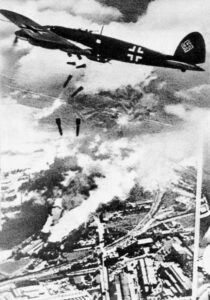
The failure of the first attacks must have come as a shock to the Germans. On the following day, the infantry once again attempted to penetrate the peninsula, but the well camouflaged shooting positions in the guardhouses proved an impassable obstacle. Therefore, the air force went into action. The Germans decided to destroy the unknown Polish positions from the air. Forty-seven Ju 87 aircraft dropped eight 500 kg bombs, 50 250 kg bombs, and 100 100 kg bombs. One of the bombs hit directly on guardhouse No. 5 burying seven defenders inside.
The raid resulted in a situation that remains highly controversial still today. What is certain is that Major Sucharski ordered secret ciphers to be burnt to prevent them falling into enemy hands. According to some, he suffered a nervous breakdown and was even said to have announced capitulation and raised the white flag. This was supposedly opposed by his deputy, Capt Franciszek Dąbrowski. Was this indeed the case? It is difficult to decide unequivocally.
Further fighting
In the following days, the Germans continued their attacks. They tried firing from the Bay of Gdańsk, but it was not as effective as they had assumed. In addition, one mismeasured shell fell between oil tankers in Gdańsk-Letniewo, while three more exploded directly in the middle of the harbour canal. As a result of the unfortunate shellings, offensive operations from the sea were abandoned. However, the Germans were convinced of the existence of very modern defensive facilities at Westerplatte. In their opinion, the bunkers were furthermore connected by underground passages. However, the increasingly sparse but still overgrown battlefield trees prevented them from assessing the situation correctly. It was therefore decided to use petrol tanks and flamethrowers. At 3 a.m. on 6 September, the Germans made their first attempt at setting fire to the forest, by rolling a tanker filled with benzol along a railway track. The operation failed, as the tanker wagon only reached its own buffers, where it stopped and exploded. The German troops had managed to withdraw earlier. The ignition of the forest with flamethrowers by the pioneers also failed. At around 3.45 p.m. the Germans renewed their attempt to set fire to the forest. This time two tanker wagons filled with benzol arrived at the intended location, but the poorly developing fire was extinguished after 15 minutes.
‘Westerplatte still defending itself!’ – the words of a Polish Radio announcer during the first days of September 1939 gave hope not only to the thousands of Polish soldiers fighting an unequal battle against German aggression, but also to the entire Polish society. The crew, which was supposed to hold out for six to twelve hours, fiercely repelled the attacks for seven days.

Capitulation
On 7 September, the German side decided to once again make use of Schleswig-Holstein, which was standing in the port of Gdańsk. It fired not only from the main artillery, but also from smaller calibre guns. The main target this time was the earth-filled shelter and guardhouse No. 2, which was eventually hit. Once again, gasoline was also used to attack. This time effectively. In addition, anti-aircraft artillery fired into the treetops, where the snipers, who had never been at Westerplatte, were supposed to be hiding….
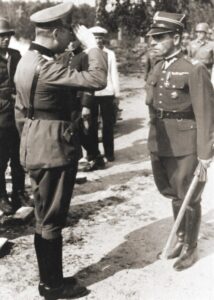
The infantry assault was repulsed, but it was the final triumph of the Westerplatte crew. Another day of unequal combat; without a moment’s rest, water or warm food, but with a tally of 15 dead and several dozen wounded, under the fire of guns, mortars, mine-throwers, and aerial bombs, the crew persisted in their ruined fortifications. It withstood 17 massed shellings, repulsed 14 attacks and 19 night raids. Resistance, however, was futile. At 10.15 a.m. (9.30 a.m. according to some) the Germans spotted the white flag. In recognition of the Polish army’s bravery, the Germans allowed the commander, who went into captivity, to keep his sabre.
Controversy
The defence, which lasted almost seven days, is still the subject of many myths, and numerous studies, films, broadcasts and even plays have been written about it. It all boils down to what orders the depot actually had? Popular opinion says that they were supposed to last six (possibly twelve) hours. Except that this referred to a local provocation by the Germans in Gdańsk. The situation on 1 September was completely different. Major Sucharski was most likely visited the day before the attack by the head of the Military Department of the Polish Commissariat General in the Free City, Lt Col Wincenty Sobociński. He passed on some information to him because, according to the military hierarchy, he had no right to give him orders. Did he inform him that the relief for Westerplatte would not come? Did he give him an order to fight for twelve hours? Much has been written on this subject, and there is still no certainty as to the course of events. Perhaps this was the reason why Major Sucharski wanted to end the defence after the attack on guardhouse No. 5. Without new sources, this cannot be conclusively determined. There are those today who claim that even the capitulation on 7 September was too hasty….
Different studies also offer varying numbers of dead. According to the latest research, 15 soldiers perished on the peninsula, one of which later in a Gdańsk hospital. After the surrender, the Germans also took a radio operator, who never returned. After recent archaeological investigations, we know for sure that nine defenders and their commander (whose ashes were deposited in the old cemetery in 1971) are buried in the Westerplatte cemetery, which was handed over in 2022. The body of one has been deposited in the cemetery at Zaspa in Gdańsk. Where are the others?
Author: Daniel Czerwiński – PhD, employee of the History Research Office of Institute of National Remembrance
Translation: Mikołaj Sekrecki