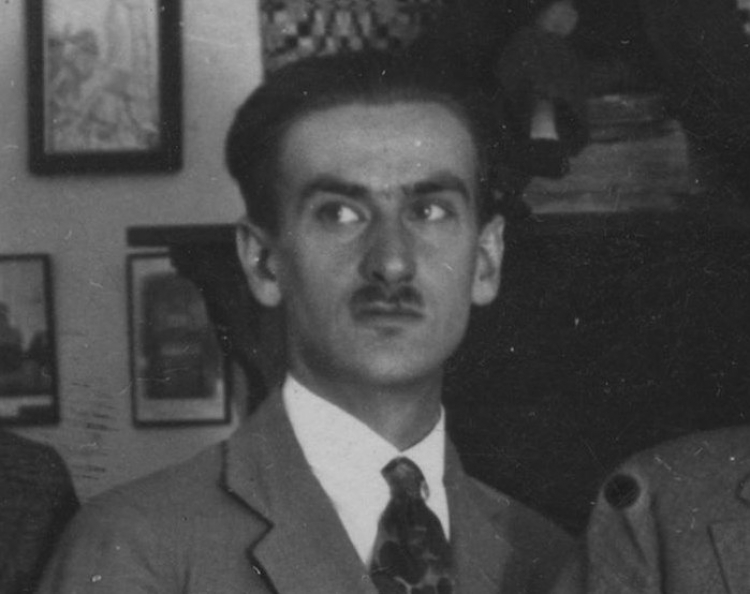
He was an implacable anti-communist, stubborn and consistent in his views. Ethnic, national, and class perspectives were relegated to the background when it came to individual freedom. That is why he had the greatest empathy for the defeated whom the world forgot after the Second World War.
by Piotr Abryszeński
‘I am in favour of accuracy, because it seems to me that only the truth is interesting. But, at the same time, the truth is usually richer, more multifaceted and more colourful than its contrived alterations. (…) The truth is also usually more shocking, more grim or more exciting, more “sensational” and more “criminal” than fanciful sensational and criminal novels (…). For it has always been my ambition to render the truth as accurately as possible, if only at the risk of angering those who do not like it,’ wrote Józef Mackiewicz in 1973.
Józef Mackiewicz was born in Saint Petersburg on 1 April 1902 into an impoverished noble family. At the age of seventeen, he volunteered to take part in the Polish-Bolshevik war. After the war, he chose to study natural sciences, which he did not complete for financial reasons, so he decided to become a journalist. He soon began publishing in the conservative Vilnius daily Słowo, whose editor-in-chief was his older brother, Stanisław Cat-Mackiewicz. His burgeoning career was interrupted by the outbreak of the Second World War, and his native Vilnius region came under Soviet occupation. After the Soviets handed over power in Vilnius to the Lithuanians, Mackiewicz was banned from publishing. He and his wife lived in poverty, and he worked as a lumberjack and coachman. After the city’s occupation by the Germans in the summer of 1941, he categorically refused an offer to write for the press published by the Nazis.
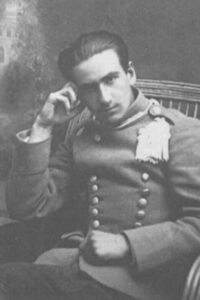
After the war, he found himself in exile. He searched for his own place, finally settling in Munich. In communist-ruled Poland, Mackiewicz’s works were strictly prohibited from publication. If his name was mentioned, it was only in the context of accusations of collaboration with Germany during the Second World War. This allegation was first made in 1942. The crowning proof was the case of collaboration with the Vilnius ‘reptile’ daily Goniec Codzienny. On the basis of rather vague evidence, the Polish underground passed a death sentence on the writer. Sergiusz Piasecki, a prominent author with an adventurous life story, and Home Army soldier during the war, was appointed to carry out the sentence. Piasecki refused to shoot Józef Mackiewicz, and the commander of the Vilnius District of the Home Army, Lieutenant Colonel Aleksander Krzyżanowski, decided to acquit the writer.
Significantly, some of these accusations were repeated until the death of the author of Kontra [Contra], even by influential figures in the Polish émigré milieu, who were very sensitive to the issue of betraying the Polish cause. In practice, the aim was to discredit Mackiewicz’s firm anti-communist views and, in the background, was also the motif of the activities of Soviet agents aiming to eliminate the inconvenient writer from the readers’ consciousness. Irrespectively of this, the writer’s opponents more than once mentioned the controversy surrounding the alleged collaboration. Years later, Włodzimierz Bolecki, a literary historian, described the case in detail, and refuted the accusations against the writer.
In exile, he lived in poverty with his wife Barbara Toporska, supported chiefly by modest royalties. When he received a prize from Paris-based Kultura, which offered a chance to boost his budget, he refused, explaining that the reason for the verdict was objectionable. In this radical way, he demonstrated his attachment to a clear system of values and honesty towards himself and others, and, at the same time, provided proof of what he advocated in his writings: the sovereignty of the individual is the most important. And it is unconditional.
Over the graves in Katyn
Following the outbreak of the German-Soviet war in 1941, mass graves of Poles murdered by the NKVD in the spring of 1940 were discovered. As a result of this genocidal crime, the Soviets murdered nearly 22,000 Polish prisoners of war, including 10,000 officers. The aim of the operation, approved by Stalin, was to destroy the intellectual and military elite, and prevent their participation in the future reconstruction of Polish statehood. The Germans decided to use this crime for their own propaganda purposes, and began exhumation work on 11 April 1943. A few days later, the government of General Władysław Sikorski turned to the International Red Cross for help, but Stalin blocked the intervention of this organisation. The Germans therefore set up their own – the International Medical Commission – which included experts from various countries, including France, England, and the United States. With the consent of the Polish government-in-exile, and the Polish independence underground, several Poles took part in the work of the Commission, including Józef Mackiewicz, Ferdynand Goetel, and, on behalf of Cardinal Adam Sapieha, Father Stanisław Jasiński.
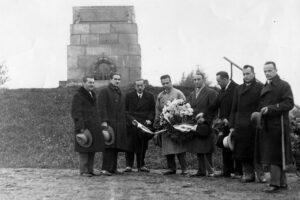
As a result, also with the consent of the Polish government, he gave an interview-account titled I saw it with my own eyes about the exhumation for Goniec Codzienny, published by the Germans. This step was decided upon due to the fact that the press licensed by the occupier had a much greater reach than the Polish press published in the underground.
Mackiewicz returned to the Katyn issue many times later. In 1948, an extensive report with a foreword by General Władysław Anders was published in London, entitled The Katyn Massacre in the Light of Documents. The main contribution to this publication was made by Mackiewicz, although – with the author’s consent – his name was not mentioned. A year later, another famous book was published, Katyń. Zbrodnia bez sądu i kary, which was soon translated into many languages; in 1951 it was published in English as The Katyn Wood Murders, and was the first book devoted to the Katyn crime in that language. A few months after its publication, Mackiewicz was summoned to a hearing before the Madden Commission set up by the US Congress to investigate the crimes against Polish officers.
An uncompromising anti-communist
Mackiewicz was, above all, a champion of individual freedom. And it seems that, precisely in the 20th century, so strongly marked by totalitarianisms restricting independent thought, his voice should not only be well understood, but should also become part of the broad discourse. However, this did not happen. In a turbulent century, he emphasised the universal perspective. That is why, when asked about his nationality, he ostentatiously stated: ‘anti-communist’. This attitude thus grew into an identity sphere that rejected European nationalisms, as well as every form of totalitarian attack on human freedom.
His adversaries quickly reduced his thought to the category of intransigent anti-communism, which did not recognise any compromises. Indeed, Mackiewicz did not intend to discuss matters with communists, and also criticised the postulate of dialogue with ideology, whose adherents naively believed that, in this way, peaceful coexistence could be achieved, and the spectre of total war averted. Whether in its radical, Stalinist version or in a milder one, issued by Khrushchev and his successors, communism – in his eyes – had an undeniably expansive character.
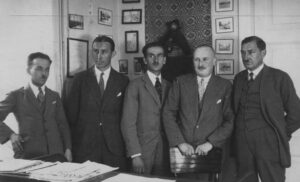
Mackiewicz did not analyse the consecutive stages of degeneration and modification of the system, and so, in comparison with the valuable observations made by eminent Polish Sovietologists, he could almost be regarded as an ignoramus. He did not ignore this vision and emphasised that, irrespective of the mask it wore, the core of the criminal ideology remained the same. This is an original and noteworthy view, especially in the context of the romance of cultural and political figures in the West with various forms of communism. In his view, the West made a logical error in treating communism as a product of the less civilised, even barbaric East. The criminal ideology was not born in Russia, but was implemented there from Western Europe, and, as such, had a supranational dimension, the writer reminded the reader. The Bolshevik carnage of 1917 was not a typical overthrowing of the ruling and degenerate power, but a brutal attack on the eternal world order. Mackiewicz did not, therefore, identify communism with Russianness; on the contrary, he regarded the ideology as its negation on all levels, from religious and political to psychological.
For most of his opponents this opinion was unacceptable – also the majority of Polish émigrés did not wish to accept this perspective. For Russia was treated as a synonym of oppression, stifling Polish aspirations for independence, a policy of denationalisation and repression, and Soviets were seen as the successors and continuators of a policy of tyranny. Mackiewicz emphasised that it was Russia that became the first victim of the criminal system.
Better death than captivity
Already at the beginning of his pontificate, Pope John Paul II, whose youth had been strongly marked by the catastrophe of the Second World War and the two occupations – German and Soviet – stressed that the aim of the Church should be to prevent bloodshed. The Polish Pope strove for a peaceful defeat of communism, although he was conservative in his statements and did not speak directly about the Soviet Union as the source of enslavement of societies east of the Oder River. ‘After all, it is difficult to imagine that the Pope and the morality of public opinion today could judge the war against Hitler as a “crime” (…). Everyone will agree that it was a just war, and that without this war Nazism could have continued to rage on earth. Why then should the war against communism be a “crime”? It seems to me that every war against a criminal should be considered right and just,’ Mackiewicz wrote in the completed version of The Victory of Provocation. This does not mean, however, that he was a supporter of armed conflict. On the contrary, he regarded it as a collapse of civilisation.
Towards the end of his life, however, he allowed for the possibility that regimes might fall without resorting to violence. Regardless, he criticised the conciliatory attitude of the Church, which had its source in the Vatican’s eastern policy since the pontificate of John XXIII. He expressed this in his books In the Shadow of the Cross (1972) and Vatican in the Shadow of the Red Star (1975). He also opposed the attitude of the bishops in Poland, headed by Cardinal Wyszyński. In his Prison Notes, recorded during his internment, the Primate wrote: ‘I have been from the beginning and am still of the opinion that Poland, and with it the Holy Church, has lost too much blood during the Nazi occupation, that it cannot afford any more blood loss now. This process of spiritual bleeding must be stopped at all costs, so that we can return to normal life, necessary for the development of the Nation and the Church, to ordinary life, so difficult in Poland.’ Mackiewicz radically opposed this view, stressing that not dialogue, but the absolute suppression of communism, should be the goal of the free world. In that spirit, he was sceptical about the formation of ‘Solidarity’ as aiming at improving and repairing the system, rather than overthrowing it.
Communism stripped man of his dignity, and even degraded human speech by changing the original meaning of terms, making it impossible to call things by their proper and precise names. The immanent feature of this ideology was therefore lies. And a total lie at that. As Włodzimierz Bolecki notes, Mackiewicz did not consider communism to be a political opponent with whom one could conduct any programme dispute on equal terms, since a democratic dispute presupposes respect for and recognition of the adversary. One cannot have a dialogue with a criminal who aims at suppressing freedom.
Nature and people
Emphasising the experience of the individual in his novels, he did not concentrate on the easiest and most obvious presentation of the individual experience of a selected protagonist, but showed the mechanisms governing this experience. He illustrated fates marked by tragedy in a manner original for a novel – by adapting the cognitive perspective. He willingly resorted to details to which, as an insightful naturalist, he attached particular importance. All this was done in order to present facts above all, and to force the viewer to draw his own conclusions.
Another novelty was the development of the characteristics of the realistic novel with a deep search for sources enriched with the technique of reportage. The author of Kontra was a brilliant observer, and had a gift for empathising with the situation of the characters he described – their motivations were complex, eluding simple judgement. These were characters without charisma, not as colourful as one might expect from fiction, but precisely human, not free of flaws, often entangled and making wrong decisions. After all, it was not the rightness of professed views that mattered, but the possibility of expressing them freely. In Mackiewicz’s prose, man became a victim of historical storms and of a merciless political machine, which, reduced and stripped of its dignity, instinctively fought for survival. This was a violation of nature, and the greatest sin of the 20th century.
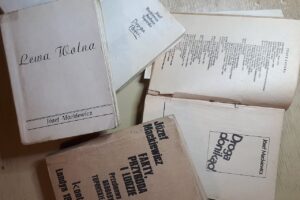
As a writer, he was consistent and, although he wrote only six novels, he managed to create a wide panorama of enslavement in totalitarian systems, starting with Lewa wolna [Left: All Clear], where he described the Polish-Bolshevik war. His most famous novel, Kontra 1957), presented the drama of the Don Cossacks, citizens of the Soviet Union, who fought alongside the German army in 1941, hoping to free themselves from the yoke of communist power. Following Germany’s defeat, under the Yalta Agreements in 1945, they were handed over to Stalin by the Allies as part of Operation Keelhaul. In Colonel Miasoyedov’s Case (1962) the author showed, in turn, the fate of an officer of the tsarist army accused of espionage. Similar to the famous Dreyfus case, the case of the Russian gendarme in Mackiewicz’s version is a study of deep injustice, of the victory of the bureaucratic machine over the individual, who grew to become a symbol of the erosion of the old system. This had its consequence: by revealing the ignorance and cynicism of the elites, the progressing corruption and hypocrisy also opened the door to a deadly ideology that was soon to overthrow the old order.
Mackiewicz’s prose is difficult for foreign readers, not at all because it is untranslatable due to the Polish experience, but rather owing to the specificity of its context and understanding of concepts arising from the realities of Central and Eastern Europe. The writer avoided easy prescriptions and generalisations, and did not describe a black-and-white world. He did not avoid bitter observations, even if they in any way weakened the anti-communist message of his works and were highly critical of the democratic world – after all, he did not want to draw a strong contrast in the description of experiences to support his premise, but to show the consequences of striking at the world of universal values.
In his A Year of the Hunter, published in 1990, Czesław Miłosz wrote: ‘Mackiewicz’s novels encourage scepticism towards literature, which is constantly being prepared in a different sauce, in the sauce of the current fashion, ideology, politics, and so on. They have a vivid narrative, they make you so curious that you can’t put the book down, in other words they fulfil all the necessary conditions in the days when the novel took the place later occupied by film and television. There appears to have always been professional and non-professional literature. Nobody wanted to embrace Mackiewicz, both because he was so literarily backward, and because he was a terrible reactionary, but they read him with great pleasure. And, in my opinion, he beat his competitors writing more sophisticated prose. He beat them artistically.
In 1975, the University of Kansas nominated Mackiewicz for the Nobel Prize in Literature. Thanks to the efforts of the democratic opposition, against which he was so sceptical, his works were published outside of the censorship in the People’s Republic of Poland, thanks to which thousands of readers had the chance to familiarise themselves with his thought and works. Józef Mackiewicz died in Munich on 31 January 1985. His wife outlived him by six months. Their ashes were buried at the St Andrew Bobola Church in London.
Author: Piotr Abryszeński (PhD, employee of the History Research Office of Institute of National Remembrance)
Translation: Mikołaj Sekrecki