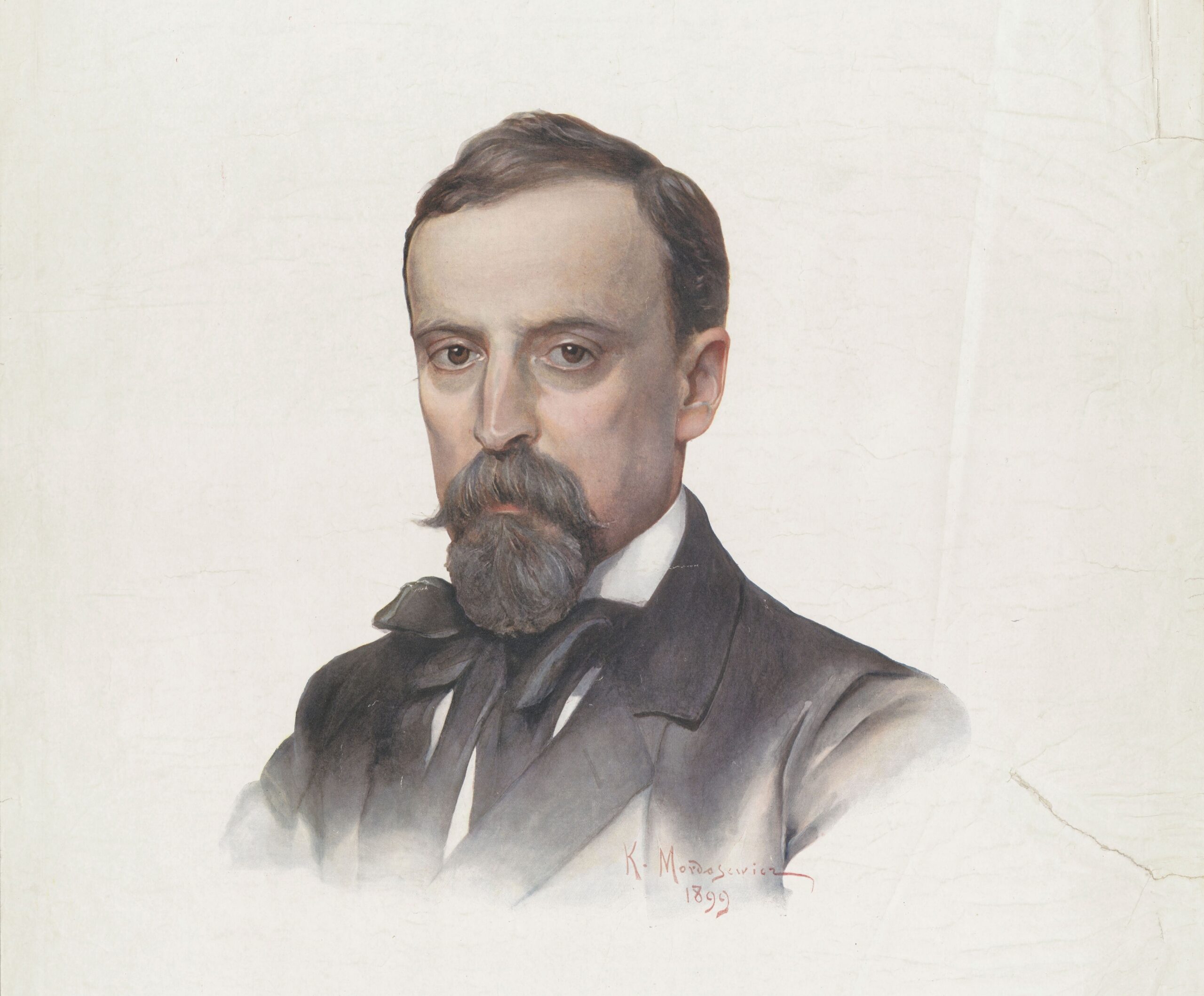
Henryk Sienkiewicz was often described as a writer who wrote “to comfort” his readers, but his prose offered much more than literary solace during the times of Poland’s subjugation. Sienkiewicz combined gripping narratives with profound reflections on history and identity, creating works that have become indelibly embedded in the collective imagination of Poles.
by Piotr Abryszeński
“This honor, precious to all, must be even more precious to the son of Poland. Poland was proclaimed dead–and here is one of a thousand proofs that the country lives; Poland was proclaimed conquered, and here is another proof that the country is capable of victory.”
These words were spoken by Henryk Sienkiewicz upon receiving the Nobel Prize for Literature in 1905. By then, he was already an accomplished writer. The world had been captivated by his historical novels and short stories, including “The Trilogy,” “The Teutonic Knights,” and “Quo Vadis.” Contrary to popular belief, Sienkiewicz did not receive the Nobel Prize solely for this last novel, which had become an international bestseller. He was honored for “his outstanding achievements in the field of epic poetry and a rare genius who embodied the spirit of the nation.”

First Attempts
Sienkiewicz was born in 1846 in the village of Wola Okrzejska, into an impoverished noble family. The traditions of the landed gentry in which he was raised left a lasting mark on his work. He spent his school years in Warsaw, but as a teenager, his education was interrupted due to the family’s difficult financial situation, forcing him to work as a tutor. He studied medicine, then law, and finally philology and history. Although he did not complete any of these studies, the knowledge he gained–particularly in Old Polish literature and language–ultimately determined his future.
Sienkiewicz made his journalistic debut and first literary attempts during his student years. He adopted the pseudonym “Litwos,” under which he published in “Gazeta Polska” and “Niwa.” At the age of 26, he published his first novel, “Na marne.” This modest work addressed contemporary themes, but did not yet foreshadow his literary talent. However, he began visiting Warsaw’s artistic salons. He was invited to the salons of Helena Modrzejewska and Deotyma (Jadwiga Łuszczewska), and became acquainted with Adam Chmielowski and Stanisław Witkiewicz.
In the second half of the 1870s, Sienkiewicz traveled to the United States as a correspondent for “Gazeta Polska.” His accounts of the lives of American settlers and the indigenous population, as well as his descriptions of the local customs and everyday realities, aroused considerable interest among readers. At the same time, Sienkiewicz used his overseas stay to inform the American public about the dramatic situation of Poles under Russian rule. While he acknowledged America’s impressive technical and organizational achievements, he also sharply criticized the brutal violence against Native Americans. These reports, written with eloquence, keen observations, and often touched with humor, became an important step in shaping his narrative craft.
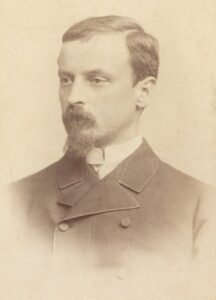
Another great prose writer of the positivist era, and also a literary rival, Bolesław Prus, vividly captured the so-called “Sienkiewicz craze” that was sparked by the writer’s vivid descriptions of America:
“After returning from America, almost every lady suspected almost any tall and handsome man of being Sienkiewicz. (…) Finally, as I kept encountering Sienkiewicz-style hairstyles at every corner, knowing that young men were growing pointed beards one after another, striving for statuesque features and a swarthy complexion, I decided to meet him in person (…) From my angle, I could see that the room was almost entirely filled with the fair sex.”
A Wholeheartedly Devoted Landowner
Sienkiewicz was a writer deeply rooted in the ethos of the landed gentry, both through his origins and the value system that permeated his work. The world of his novels is dominated by the nobility, portrayed as the primary guardians of tradition, honor, and responsibility for the fate of the state. For Sienkiewicz, they constitute the moral core of the community. Their lifestyle, language, and understanding of freedom functioned as a natural point of reference for Polish identity. Sienkiewicz viewed the world through the eyes of a landowner, marked by a commitment to social hierarchy and property, and by the belief that moral order stems from the continuity of tradition.
Critics, particularly those associated with the more radical wing of positivism, viewed this outlook as an attempt to preserve an anachronistic model of society, incompatible with the realities of modernity and the social changes of the late 19th century. Many critics, including Bolesław Prus and Aleksander Świętochowski, accused him of sentimentalism and of mythologizing noble Poland, thereby perpetuating national illusions and diverting attention from real problems.
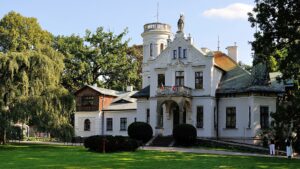
The paradox, however, is that it was precisely this landed gentry perspective that endowed his prose with its symbolic power and coherence. Sienkiewicz wrote not as an impartial historian or social reformer, but as a conscious participant in the culture of his social class, convinced that its values could provide the foundation for the survival and rebirth of the national community.
A Romantic in the Age of Positivism
The Trilogy proved to be the most powerful literary instrument through which Sienkiewicz shaped the collective imagination of Poles. The cycle of novels is set in the mid-17th century, a period that marks both the Polish–Lithuanian Commonwealth’s greatest power and an era of profound crises and wars. The series consists of “With Fire and Sword,” set during the Khmelnytsky Uprising; “The Deluge,” set during the war against Sweden; and “Pan Wołodyjowski,” which unfolds during the conflict with the Ottoman Empire. Initially published in newspaper installments, the novels gained enormous popularity almost immediately. The book editions released between 1884 and 1888 differed only slightly from the newspaper versions, which had been frequently revised and shortened under pressure of publication deadlines.
From the very beginning, the Trilogy was a publishing phenomenon. Poles lined up to buy the latest issues of “Słowa” or “Czas,” where successive installments of his stories appeared. These narratives foreground fictional characters, albeit ones inspired by real historical figures.. Sienkiewicz studied 17th-century poetry and memoirs, as well as numerous works by historians. He sought not only to describe past events but also to offer interpretations in a patriotic spirit. He aspired to be a realistic writer, but not a naturalist one, deliberately leaving room for his readers’ imagination.
SSienkiewicz’s strength lies primarily in his deliberate and intricate archaization of language and in his exceptionally evocative characterization – dynamic, clearly defined, and immersed in the era they are meant to embody. So enduring is their power that many of them survive in Polish culture and language to this day, forming part of the Polish imaginarium.
Their destinies are shaped by a distinct axiology: the struggle between good and evil, loyalty to the homeland, honor, and sacrifice. Among his notable cast of characters are Onufry Zagłoba – a ribald, megalomaniac nobleman, and gifted storyteller, a Falstaff-like figure, who, in moments of peril, finds the best solution and saves the entire company; Andrzej Kmicic, a character full of contradictions: a troublemaker and impetuous brawler, who embarks on a path of redemption and is ready to repay his debt to his homeland with interest. Finally, there is Michał Wołodyjowski – an unparalleled master of fencing, whose short stature is offset by his extraordinary courage and devotion to friends and country. He embodies the very essence of the chivalric ethos and stands as a paragon of nobility. Sienkiewicz held a special fondness for this character, referred to in the series as “the first saber of the Republic” and “the Little Knight.” He, along with Zagłoba, also appears from the beginning to the end of this epic narrative.

Sienkiewicz is said to have once been found weeping by a servant over a pile of manuscripts. When asked if something had happened, he replied, “Mr. Wołodyjowski is dead!”
The heroic death of the “Little Knight” is one of the most moving moments in Polish literature. Wołodyjowski does not die in a duel, nor does he perish on the battlefield. Instead, he dies as the defender of the fortress in Kamieniec Podolski – unconquered for three centuries and effectively protecting Poland from the Ottoman threat. The army capitulates, but not him. He remains at his post until the end.
It is therefore difficult to classify Sienkiewicz’s work solely as “uplifting.” His novels were not only tales of the past but also conveyed values, attitudes, and ideas that helped Poles survive the period of slavery and reawaken the dormant sense of identity. It is for this reason that Sienkiewicz remains one of the most important writers in the history of Polish culture.
Sienkiewicz was convinced that literature could compensate for political oppression, strengthen the community, and organize collective emotions. In this sense, the Trilogy was very much a product of its era. It was intended to rebuild social morale without calling for direct rebellion. At the same time, however, romantic elements permeate its narrative structure. The world it presents is governed by the logic of heroism, great passions, and individual actions that can change the course of history. The narrative pathos, the idealization of the former Polish-Lithuanian Commonwealth, and the belief in the special national mission of Poles place the Trilogy within the Romantic tradition of historical thought.

Sienkiewicz’s Universe
A special place in Sienkiewicz’s oeuvre belongs to “Quo Vadis.” The novel brought him international fame and made him one of the most frequently translated authors of the early 20th century. Set in Nero’s Rome, seemingly far removed from the Polish experience, the book in fact touched on issues particularly close to readers living under partition. At its core lies the conflict between violence and moral resistance, between authority based on brute force and community built on faith and solidarity.
Sienkiewicz drew on antiquity not to meticulously reconstruct it, but to create a compelling allegory of the decline of a world devoid of ethical foundations. Nero’s Rome appears as a civilization in decline – dazzling in its grandeur, but hollow at its core, mired in cruelty and the aestheticization of violence. In contrast, the world of the early Christians is modest, devoid of political power, yet capable of survival and victory in the long run, not only in the moral arena.
In the character of Petronius–an ironic aesthete and skeptic–Sienkiewicz portrayed a man of culture who fully understands the mechanisms of power yet is no longer capable of believing in them. Vinicius, on the other hand, follows a classic path of moral transformation, abandoning the logic of violence and domination in favor of responsibility and love. Lygia, though embedded in the convention of an idealized heroine, functions as an ethical point of reference and a bearer of non-negotiable values.
The enormous success of “Quo Vadis”– measured in hundreds of editions, translations, and adaptations – stemmed from its skillful fusion of a spectacular plot with a universal message. Sienkiewicz demonstrated his ability to write not only about Polish history but also about an experience shared across Europe: the crisis of civilization, the violence of the state directed against the individual, and the power of ideas born on the margins of empires. In this sense, “Quo Vadis” was a profoundly modern novel, although one dressed in an antique costume.

***
Sienkiewicz spent the last years of his life abroad, but always with Polish affairs on his mind. During World War I, he found himself in Morges, Switzerland, where, together with Ignacy Jan Paderewski, he co-founded the Swiss General Committee for Aid to War Victims in Poland. Sienkiewicz’s authority and Paderewski’s international fame allowed them to effectively reach European public opinion, raise funds, and draw attention to the dramatic situation in Polish lands devastated by the war.
He died on November 15, 1916, in Vevey by Lake Geneva, before the rebirth of the Polish state. His funeral became a national manifestation of Polish emigration. A few years later, his ashes were brought to his now-free homeland and interred in the vaults of the Archcathedral Basilica of St. John the Baptist in Warsaw.