Truso is like the legendary Troy. A single mention in a written source was enough to stimulate the imagination of dozens of historians and archaeologists eager to discover the settlement. The search, which lasted two centuries, was crowned with success. This proves that the romantic vision of the archaeology of great discoveries can sometimes come true.
by Jakub Jagodziński
Perhaps the comparison of Truso to Troy is somewhat an overstatement. For it is true that the author of the source in which the settlement was recorded was an Anglo-Saxon traveller, not an ancient Greek poet translated into likely all the languages of the world. Although Wulfstan was also an important figure at the court of Alfred the Great, King of Wessex, it is difficult to equate his literary talents with the great Homer. In fact, Wulfstan was more of a chronicler, a diplomat and perhaps spy, but not a poet. In an almost ethnographic style, he described the country of the Estes/Prussians, incidentally noting quite accurately the route he had covered. It had led from the Danish Hedeby to Truso. This brief information was enough for the search for Truso to begin a thousand years later. Although Homer and Wulfstan seemingly differ in everything, from our modern perspective they have one thing in common: they both spawned an extraordinary curiosity for research, which led to the discovery of places that had previously been mere legends.
Truso: what the settlement was and how it was discovered
In the case of Truso, German scholars did not succeed either in the 19th century or by 1945. When Elbląg and its surroundings became part of post-war Poland, attempts to find the settlement were made by Polish archaeologists and historians, but they long pointed to the wrong places. Finally, in the spring of 1981, Truso was discovered. As befits a legendary settlement, the circumstances of the discovery were also exceptional. While travelling across the Elbląg Uplands on his Huragan sports bike, the young Elbląg archaeologist, Marek F. Jagodziński, noticed that there were fragments of pottery, animal bones and small lumps of amber in a field in Janów Pomorski. He rightly acknowledged these to be traces of an ancient settlement, and, a year later, he made the first trial trench there. After several more seasons of research, it became clear that the discovery contained a special dimension – it was the legendary Truso settlement.
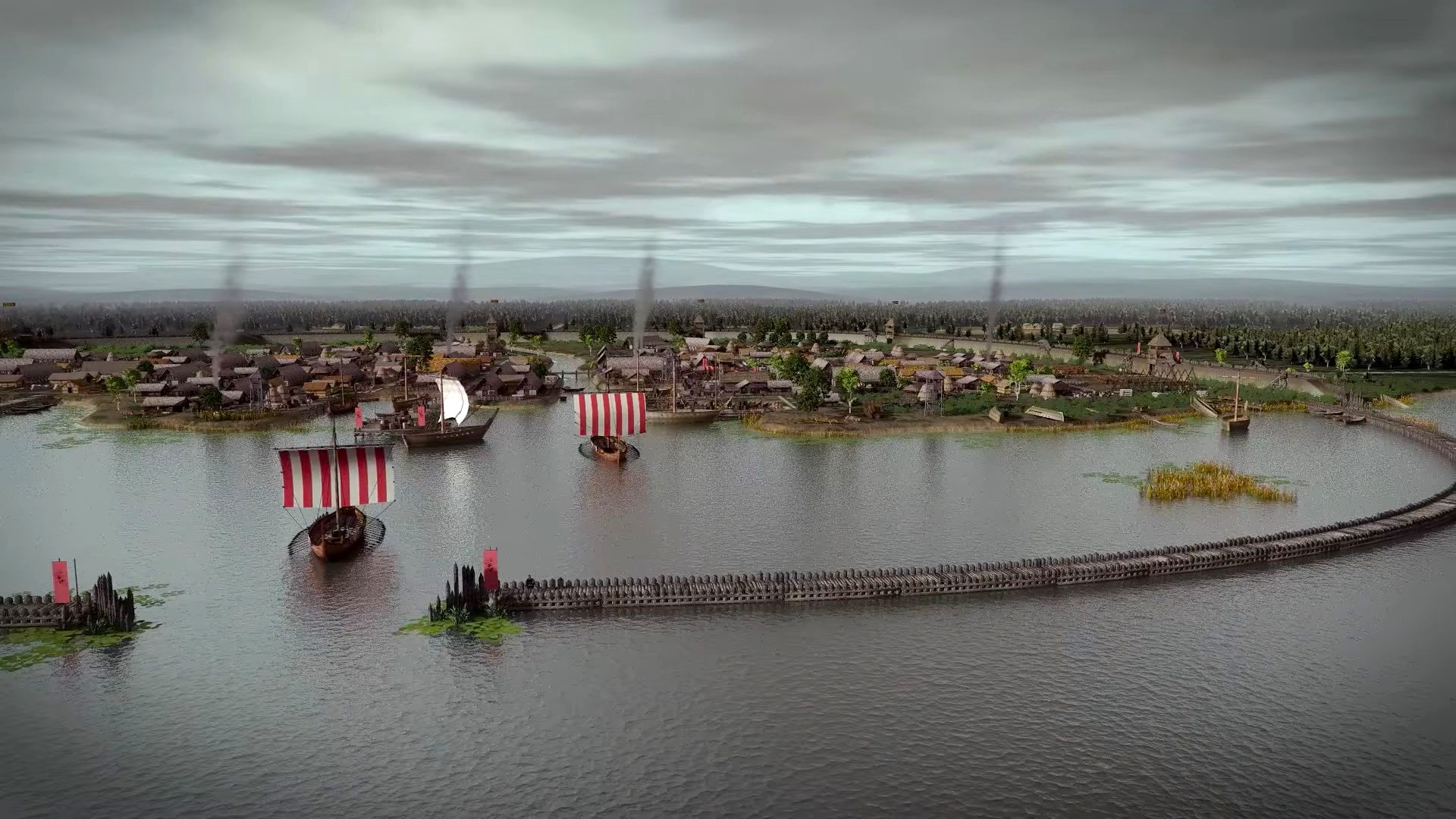
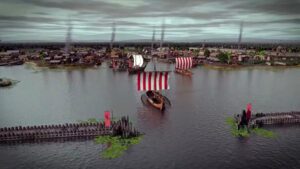
Although the area where Truso was located had been under Prussian rule in the early Middle Ages, the settlement itself had a typically Scandinavian character. It was an emporium, analogous to other centres known from Northern Europe, such as Hedeby or Birka. The settlement produced craft, offered trade and functioned as a port. On the basis of archaeological research, it can be confidently said that it was inhabited primarily by Scandinavians, most likely arrivals from Denmark. Taking into account not only the material culture uncovered there, but also other indications, i.e. the fact that Wulfstan sailed to Truso from a Danish port, and that the voyage itself took place in the Viking Age, the seemingly surprising ethnic composition of the settlement finds convincing justification. Indeed, emporia of this type were established by the Scandinavians on both sides of the Baltic Sea. They performed the same functions and were very similar in terms of the organisation of the settlement space. What were the characteristics of Truso?
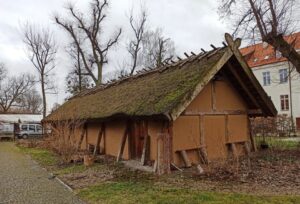
The settlement was founded at the end of the 8th century and functioned until the end of the 10th or the beginning of the 11th century. For approx. 200 years of its existence, it was a typical Viking centre with craftsmen and merchants. For the majority of that time it operated as an open settlement, and its security was ensured by its convenient location: Truso was founded on Lake Druzno, which was connected to the Ilfing River (today’s Elbląg), from where, in turn, it flowed into the Vistula Lagoon and further into the open waters of the Baltic Sea. Such location offered the possibility of convenient maritime trade while simultaneously eliminating the risk of an enemy attack directly from the open sea. The location of the settlement on the map of early medieval Europe is also noteworthy, as this was the Slav-Prussian borderland, and the surrounding population primarily consisted of West Baltic communities. Truso, therefore, formed a small Viking enclave, surrounded by foreign communities, with whom it nevertheless maintained peaceful relations. Indeed, there is no indication of mutual fighting, while objects relating to the trading system used by the Scandinavians have been preserved at Prussian sites, suggesting economic cooperation.
Truso: what do we know about its inhabitants?
The image of the Vikings being disseminated in pop culture depicts only one side of the activities of the early medieval Scandinavians. However, they were not only sea burglars and brutal warriors, as can be seen by tracing the functioning of the trading settlements they established (referred to as ports of trade in English-language literature and Seehandelsplatz in German-language sources).
Truso was also a settlement of this type. Its inhabitants were involved in a variety of crafts. The most important of these were amber-working (they made jewellery, spindle whorls, but also, for example, pawns for the board game Hnefatafl from fossil resin), jewellery-making (from precious metals, just like from amber), smithery (making swords, knives, sickles, fittings, rivets and other useful objects, such as ice-walking crampons), horn-working (bones and antlers were used to make primarily utilitarian items, such as skates, combs, needles and stitching awls), and glass-making (primarily beads). Some of the items produced were used for the needs of the settlement’s inhabitants, while others went to trade markets.
Although everything that was in demand was traded – both in the immediate neighbourhood and in distant regions of Europe and the world – in the case of Truso, trade in two goods clearly dominated. The most important export commodity was amber, which was sold both as a raw material and as a finished product. The other ‘object’ of trade were slaves – in the early Middle Ages it was the sale of people deprived of freedom that allowed the greatest profits to be made. In the case of Truso, such a practice may be confirmed by the shackles discovered during research. On the other hand, the inhabitants of the settlement imported both luxury and everyday objects, such as certain types of glass beads, but also ceramic vessels and raw materials.
Daily life, however, did not consist solely of manufacturing and trade. Archaeological research has provided interesting testimonies related, among other things, to beliefs and entertainment.
The beliefs of the Scandinavians of Truso are evidenced, above all, by various types of pendants and amulets (including pendants in the shape of Thor’s hammers, a representation of Odin, or a purported Valkyrie). Interestingly, it was in Truso that the oldest testimonies of Christianity were discovered on the territory of present-day Poland – these include liturgical vessels (jugs of the Tating and Badorf types), a denarius with a cross transformed into a pendant (a medal), an amber cross, or a depiction of Jesus in the Great Moravian type.
One of the pastimes, and an important skill, was playing Hnefatafl, a board game, the rules of which are still known today, and elements of which have been discovered in Truso in the form of numerous pawns.
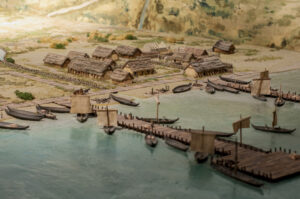
It is also worth mentioning that the settlement was inhabited by entire families, not just men. Slivers, weaving weights and even toys indicate the presence of women and children in Truso, which allows us to imagine a completely different picture of everyday life than in the case of seasonal settlements where only merchants appeared.
As can be seen, a great deal is already known about Truso although, for the purposes of this article, it has only been possible to present a very brief account of the settlement. We owe all our knowledge of it to archaeology. Over 40 years of research has provided good insight into its characteristics, and it has been possible to learn, at least to some extent, about the life of the settlement’s inhabitants. Many seasons of excavations, a dozen or so monographs, and more than 100 scientific articles have measurably contributed to the recognition and popularisation of Truso. The fruit of this research is presented at the permanent exhibition of the Archaeological and Historical Museum in Elbląg.
Author: Dr. Jakub Jagodziński
Translation: Mikołaj Sekrecki