An art historian, museologist, professor, and patriot, Karol Estreicher Jr. was one of the most important figures in the post-war reconstruction of Polish art collections. His work to recover cultural assets made him a symbol of concern for national heritage.
by Nina Kucharczyk
Karol Estreicher Jr., the only son of Stanisław and Helena, was born on March 4, 1906, in Kraków. From birth, he inherited not only a surname but also a vast intellectual and social legacy. Over the preceding two hundred years, the Estreicher family produced many distinguished professors, including two rectors of the Jagiellonian University. His grandfather, Karol Józef Teofil Estreicher, known as the Elder, initiated the publication of the monumental work “Bibliografia Polska,” encompassing Polish printed works from the 15th to the 19th centuries. Continuing and expanding this work became one of Karol Jr.’s lifelong goals.
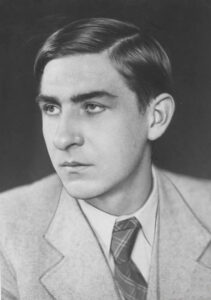
As the professor’s friend, Ignacy Trybowski, director of the Society of Friends of Fine Arts, recalled on Polish Radio in 1984: “Professor Karol Estreicher was burdened by his family’s tradition, which stretched back 200 years in Kraków. This legacy often irritated him. He never personally wanted to take credit for the achievements of his ancestors.” Despite this burden, or perhaps precisely because of it, Estreicher developed his own, deeply personal credo, which he formulated in a diary kept from September 1939: “Poland is the only thing I truly care about. Polish culture throughout the entire Polish state is the most precious thing to me. Because I know that there are nations without territory, without language, without a state, but nations without culture will not survive.” It was this love for national culture that determined all his later actions.
We owe him the rescue and recovery of many priceless works of art looted by the Germans during World War II. His role as a guardian of heritage became apparent even before the outbreak of the conflict. As Professor Jerzy Wyrozumski, Secretary General of the Polish Academy of Arts and Sciences, wrote in his study “Karol Estreicher Jr. – Lover of Kraków”: “Karol Estreicher’s initiative to secure Kraków’s most valuable collections in the event of war with Germany deserves special attention. The matter was discussed by the Department as early as March 23 and September 30, 1938, relatively early on.”
In Wyrozumski’s opinion, Estreicher was the driving force behind the campaign to save historical monuments. In the second half of August 1939, with the consent of Archbishop Adam Sapieha of Krakow, he arranged for the dismantling of the Veit Stoss altarpiece and its transport to Sandomierz, where it was hidden in the local cathedral and seminary. Unfortunately, after the occupation of Poland, the Germans found the altar dismantled into 2,000 pieces and took it to Nuremberg.
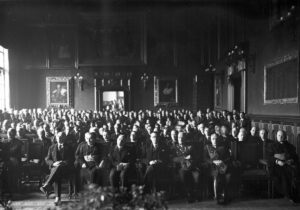
Karol Estreicher emigrated and became secretary to General Władysław Sikorski. His determination to save the nation’s treasures remained unwavering. During the French campaign in June 1940, as Nawojka Cieślińska-Lobkowicz recounted, “Karol Estreicher arrived in Aubusson, bringing three suitcases of cultural property deposited in the vaults of the Banque de France on behalf of the Polish government-in-exile: 21 musical manuscripts by Chopin, 22 first editions of books from the National Library in Warsaw, including the oldest Polish manuscripts, and a Gutenberg Bible.”
Estreicher himself described the subsequent evacuation of Polish treasures from France to Great Britain, and his account reads like the plot of an action movie: “June 17: I encountered Sikorski at the exit: ‘Mr. General, save the Wawel treasury.’ ‘Save it yourself, I have to save the government of the Republic of Poland.’ ‘Okay,’ I said.”
He managed to load the priceless treasures onto the ship, and during the dramatic voyage, as Cieślińska-Lobkowicz recounts, “he tied Szczerbiec (the crown sword of Polish kings) to a plank, hoping that if the ship sank, it would at least survive.” It’s hard to resist the impression that these notes could have inspired the screenwriter of “Raiders of the Lost Ark.”
Upon arriving in England, Estreicher became head of the Polish Cultural Property Restitution Office in the Polish government in London. With a documentarian’s zeal, he kept a record of losses and displacements of cultural property, as well as a file listing the names of thieves and art destroyers, ultimately collecting data on over 600 individuals. As his nephew, Professor Stanisław Grzybowski, recalled, “He couldn’t just work at a desk. He traveled through Francoist Spain and the French Zone Libre to Switzerland to collect materials on these losses, provided by Polish and British intelligence.”
In 1942-43, he lobbied for the establishment of an international organization dedicated to restitution, and from 1944, he served as a member of the Allied Commission for the Protection and Return of Cultural Property. In March 1944, at his own expense, he published a catalog of over 300 pages, titled “The Cultural Losses of Poland,” which he distributed to Allied soldiers. Thanks to his titanic work, Poland was the only country prepared for restitution immediately after the war. As early as May 1945, Allied soldiers discovered and handed over to him the Codex of Balthazar Behem. In a bunker beneath Nuremberg Castle, he also discovered Veit Stoss’s St. Mary altarpiece, whose wartime fate he had meticulously tracked through intelligence channels.
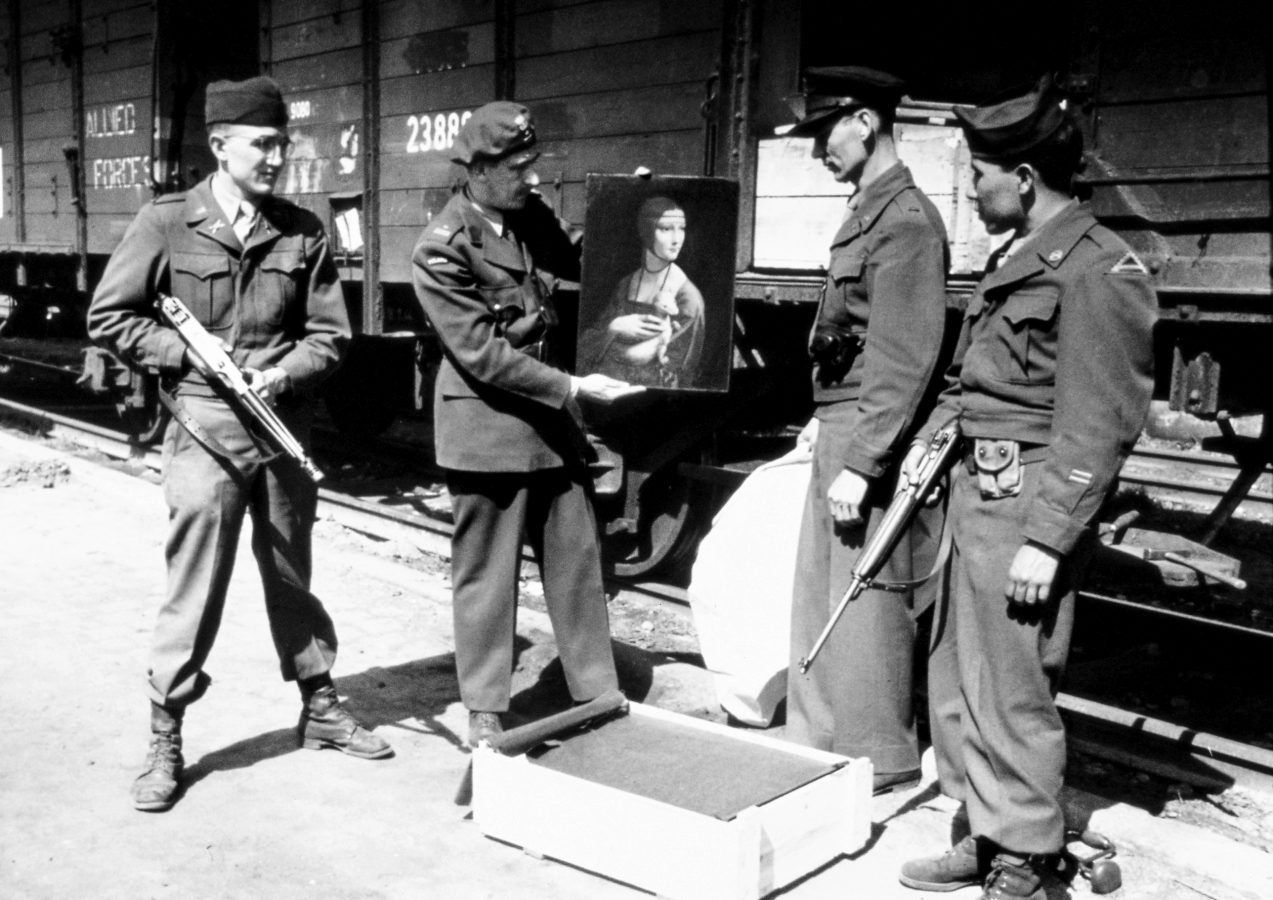
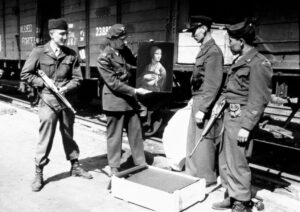
Estreicher’s return to Poland was crowned by one of his greatest triumphs: in April 1946, a train carrying over 26 carriages filled with looted works of art departed from Munich station. Among them were Leonardo da Vinci’s “Lady with an Ermine,” Rembrandt’s “Landscape with the Good Samaritan,” 15 carriages containing the Jagiellonian University collection, four carriages containing religious objects (including over 2,000 chalices), four carriages containing the St. Mary’s altar, two carriages containing Wawel memorabilia, and one carriage containing the treasures of the Czartoryski Library. On April 30, 1946, the train arrived in Krakow. Karol Małcużyński, who was covering the Nuremberg Trials at the time and was on that train, recalled: “It was an unforgettable journey. The train was under American military escort, under American command, and flew the American flag. But I can assure you that, in fact, Karol Estreicher was in command of the train, the escort, and the commander of the train.”
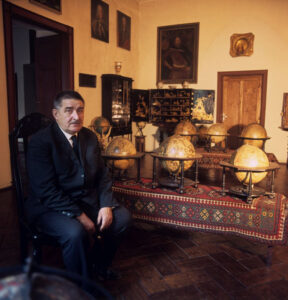
After returning to Poland, Estreicher began teaching at the Jagiellonian University and, for 20 years, devoted himself to restoring the Collegium Maius building, which housed the Jagiellonian University History Museum, where he also served as director. He was influential but also controversial, never shying away from conflict. Professor Stanisław Salmonowicz described him as “a Renaissance figure, often defying the rigid confines of university etiquette, or, more broadly, even the orderly relationships between people, usually governed by various conventions.” This rebellious nature weighed heavily on his later life. In 1964, he signed the “Letter of 34.” Two years later, his application for the title of full professor was rejected, and he became a victim of a defamation campaign instigated by the Security Service. During the March 1968 events, he was beaten by the ZOMO (Motorized Reserves of the Citizens’ Militia) for defending students, as reported by Radio Free Europe, and was subsequently forced into retirement.
Despite harassment, he remained active. For 26 years, he served as president of the Society of Friends of Fine Arts, chaired the Kościuszko Mound Committee, and was an honorary member of the Society of Lovers of Kraków History and Monuments. He was also involved in local affairs, opposing the closure of the Dominican stalls, relocating the church in Komorów to Wola Justowska, and, after its fire in 1978, overseeing the reconstruction of the wooden church.
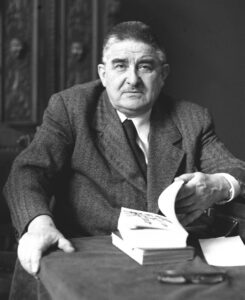
Karol Estreicher Jr. was not only a continuator of the family bibliographic tradition but, above all, a tireless defender of Polish cultural heritage. His life, marked by a heroic struggle to save national treasures and later by resistance to the communist regime, is a testament to the steadfast stance of an intellectual for whom culture was the essence of national existence. His diary statement, “Poland is the only thing I truly care about,” became the motto of his entire life and work.
Author: Nina Kucharczyk
Transation: Alicja Rose & Jessica Sirotin