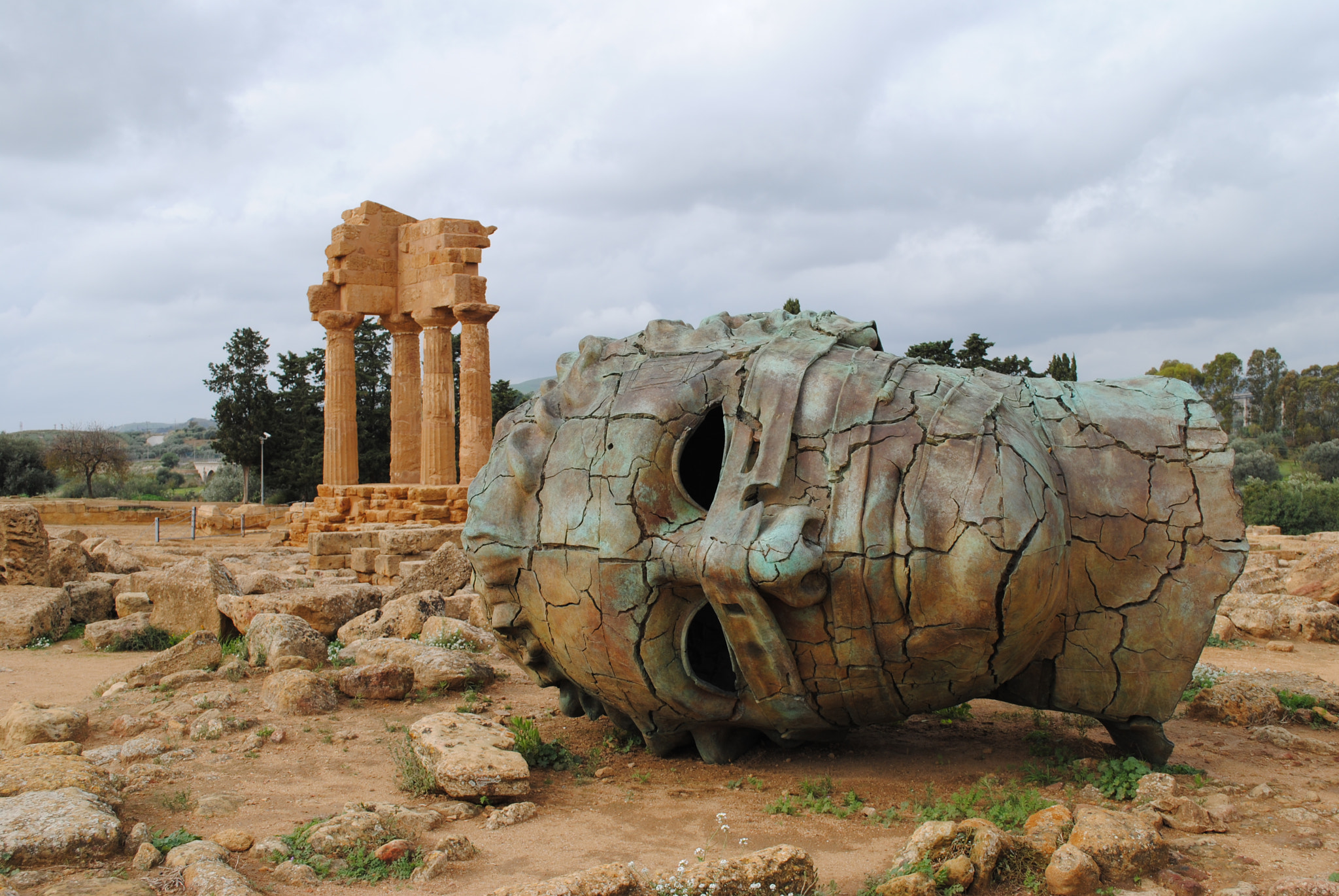
In 2004, Igor Mitoraj’s colossal, fractured heads stood among the ancient columns of the Roman Forum, giving many the sense that time had come full circle. His Eros Bendato – a monumental, bandaged face, crisscrossed with deep scratches and cracks – gazed upon the tourists with an air of eternal pain, as if bearing witness to humanity’s tragedies while remaining mute. But who was this man who could revive forgotten myths and make marble speak to modern viewers with a force unmatched by digital images and multimedia installations?
by Nina Kucharczyk
Art as an Escape
Igor Mitoraj was born in 1944 in Oederan, Germany, as Jerzy Makina – a child of wartime chaos, born in the shadow of violence and captivity. His mother, Zofia Makina, was a Polish forced laborer, and his father was a French prisoner of war of mixed Polish-French descent. After the war, he came to Poland, to Grojec near Oświęcim, where he grew up in a modest post-war home, surrounded by a trauma no one yet knew how to name.
It was only after his mother married Czesław Mitoraj that he adopted his surname. Later, as an adult artist, he also changed his first name: “Jerzy” to “Igor,” seeking not only an international advantage but also a symbolic distance from his past.
His path to art was far from that of a “child prodigy.” After graduating from the Art High School in Bielsko-Biała, he worked as a salesman and artist at a chemical plant in Oświęcim. Initially, art was more of an escape than a career. Only in 1966 did he begin his studies at the Academy of Fine Arts in Kraków, where he came under the guidance of Tadeusz Kantor, the charismatic master of the avant-garde. Kantor taught him to think of art not as decoration, but as an act of resistance—a way of breaking free from convention and expectation.
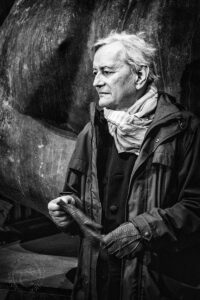
But the People’s Republic of Poland was not a place where his artistic rebellion could fully express itself. After the events of March ’68, Mitoraj—like many artists of that era—decided to emigrate.[1] He chose Paris, which for an artist of his generation was similar to what Florence had been for the Romantics.
Myth Is Hidden Within the Form
In Paris, he first focused on graphic art and painting. Though his works, still rooted in modernist language, attracted attention, they did not fully satisfy him. His breakthrough came in 1974, when Mitoraj traveled to Mexico. It was there that he encountered the monumental art of the Aztecs, Mayans, and pre-Columbian civilizations, and it was a revelation. He realized that form could be not only aesthetic but also ritualistic, a vehicle for emotion, memory, and even myth.
He soon abandoned painting in favor of sculpture. In 1979, he moved to Pietrasanta in Tuscany, a small town located just outside Carrara, famed for its marble quarries once used by Michelangelo and Canova. Like them, Mitoraj was captivated by Carrara’s white marble. “When I first touched that stone, I felt as if the spirit of the past had spoken to me,” he recalled.
He eventually established his studio in Pietrasanta, where he lived among other great artists, including Henry Moore. It was there that he developed his distinctive style: monumental classical forms, often marked with deliberate damage—cracks, missing limbs, and distortions that could not be attributed to erosion or the inexorable workings of time.
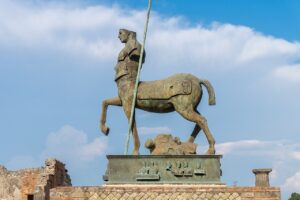
Igor Mitoraj did not copy antiquity; he transformed it. His sculptures evoked Greek and Roman statues but were deliberately “mutilated.” Rather than striving for perfection, he exposed imperfection, treating it as an integral part of beauty.
In his “Icaria,” we see a figure with broken wings—not as a sign of triumph, but of defeat and fall. The Gorgon has the lower half of her face severed, as if her scream had been erased. “Tindaro Screpolato,” on the other hand, depicts a man cracked like an old vessel. His works thus raise the question: can beauty be complete if it bears no traces of suffering? Mitoraj’s answer was no. “Viewers asked me why I destroy beauty. And I said: I don’t destroy it – I show its true face.”
Mitoraj as a Trend
Although his works were exhibited in prestigious galleries and museums – from New York to Tokyo – he remained virtually unknown in Poland for a long time. Only in the 1990s, when the global art market went wild for his work, and prestigious auction houses like Sotheby’s and Christie’s sold his sculptures for hundreds of thousands of euros, did the Polish public begin to take notice.
In 2005, he created the monumental doors for the Basilica of Santa Maria degli Angeli e dei Martiri in Rome, adorning them with, among other things, an image of John Paul II – a tribute not only to the Polish Pope but also to his own roots.

Today, his works can be found in many Polish cities, including Kraków, Warsaw, Poznań, and Płock. “Eros Bendato” on Kraków’s Main Market Square has become a favorite meeting place, and, as critics note, a symbolic reflection on a city caught between the past and modernity. It’s impossible to discuss his legacy without mentioning how he restored marble to the status of a contemporary material. In an era dominated by steel, glass, and artificial materials, Mitoraj humbly embraced classic stone but for a different purpose. His marbles weren’t pure, perfect, or polished to a smooth finish; they were rough, cracked, and raw. They carried history.
Young artists studying sculpture in Pietrasanta today often recall Mitoraj as a spiritual mentor. Someone who showed that art doesn’t need to be reinvented to be relevant. One only has to listen to the stone, and it will speak.
His sculptures weren’t confined to museums. They stood, and still stand, in squares, parks, and before temples—and this was a deliberate act on the artist’s part. For Mitoraj, sculpture had not only form but also context. In public spaces, it gained new meaning: a sign, a disruption of everyday life. In Kraków, his “L’Homme à la Tête Coupée” does not dominate the space, but contemplates it. In Płock, “Tindaro Screpolato” blends into everyday urban life like a scar on flesh. In Rome, the monumental doors to a basilica aren’t just an entrance to a temple, they’re a threshold between the sacred and suffering.
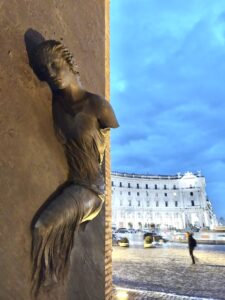
Mitoraj left no manifesto. He founded no school and launched no new art movement. What he left was something more valuable: a space for silence, a place for reflection, a crack through which to look deeper. In an era obsessively pursuing perfection, his sculptures remind us that beauty isn’t a smooth surface. It’s what cuts through it. A shadow on a face. An eye that never fully opens.
Igor Mitoraj showed that even a statue without an arm or head can tell more about the human condition than the most flawless features. Because art—like life—doesn’t have to be complete to be true. And that is why his legacy endures – not only in marble, but also within us, the viewers of his works.
[1] In March 1968, a series of student protests in Poland were initiated by the government’s ban on a play and broader demands for free speech. The communist regime responded with violent crackdowns, political purges, and an antisemitic campaign that forced thousands of Polish Jews to emigrate.
Author: Nina Kucharczyk
Transation: Alicja Rose & Jessica Sirotin