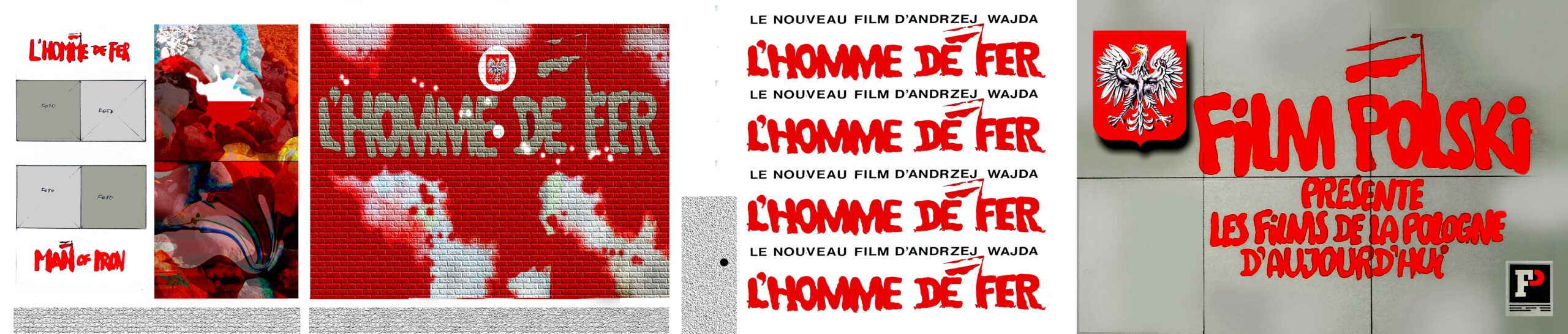
This feature drama directed by Andrzej Wajda was made in early 1981 on the basis of a script by Aleksander Ścibor-Rylski, as a continuation of the celebrated and outstanding Man of Marble (1976). To this day, it is the most famous feature film telling the story of the strikes of August 1980 and the birth of ‘Solidarity’.
by Piotr Brzeziński
Andrzej Wajda recalled that the idea for the film had been born in the Lenin Gdańsk Shipyard at the end of August 1980, when – as a well-known director – he was asked by one of the shipyard workers if he could make a film about them. A popular anecdote has it that Wajda then asked his interlocutor what the title of the film should be, and heard the reply: Man of Iron. Shortly afterwards, the director confirmed his intention to make a film about shipyard workers in an interview published in Strajkowy Biuletyn Informcyjny Solidarność.
The film is set in Gdańsk in August 1980. Working for the government media, journalist Winkel (played by Marian Opania) is commissioned to record a reportage showing one of the members of the Interfactory Strike Committee (Polish acronym ‘MKS’ for Międzyzakładowy Komitet Strajkowy), Maciej Tomczyk (Jerzy Radziwiłowicz), in a negative light. Tomczyk is the illegitimate son of the protagonist of Man of Marble, Mateusz Birkut (also played by Jerzy Radziwiłowicz). While gathering material for his reportage, Winkel meets his old colleague Dzidek (Bogusław Linda) in Gdańsk, who tells him about Tomczyk and shows him archival film footage of the pacification of workers’ protests on the Coast in December 1970 by the army and police.
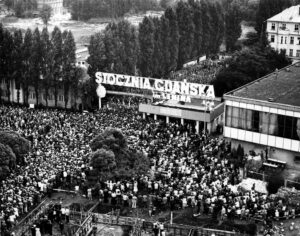
With the help of the secret service, which commissioned the documentary, Winkel also meets Tomczyk’s wife Agnieszka (Krystyna Janda), a film director and oppositionist currently held in custody. The two know one another from the time when Agnieszka had unsuccessfully attempted to make a documentary about Mateusz Birkut, which was the idea behind the Man of Marble. Over time, Winkel begins to sympathise with the striking workers, and even, rebelling against his superiors, resigns from making the propaganda footage. At the same time, he witnesses the signing of the historic Gdańsk Agreement, concluded on 31 August 1980 by the Gdańsk MKS with a government commission headed by Deputy Prime Minister Mieczysław Jagielski, at the Gdańsk Shipyard.
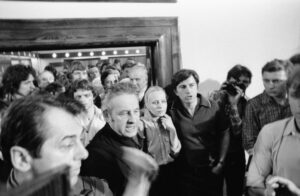
For the film plot, it was extremely important to make a final decision (taken already during the production of the film), who the main protagonist would be. For a long time, Maciej Tomczyk was considered the person who would lead the strike (i.e. someone like Lech Wałęsa). In the end, however, the director decided that he would be the second-ranking activist of the Free Trade Unions, and the person who initiated the strike (here an irresistible association with Jerzy Borowczak comes to mind). This made it possible to include Lech Wałęsa in the plot, who, for the purposes of the film, starred in two fictionalised scenes (the wedding of Maciej Tomczyk and Agnieszka, and the signing of the Gdańsk Agreement), thus further reinforcing the credibility of the film’s message.
In Wajda’s film, fictional scenes are repeatedly interspersed with original archival footage from December 1970 and August 1980. Several fictionalised scenes also feature authentic historical figures, such as Jerzy Borowczak, Tadeusz Fiszbach, Anna Walentynowicz, and Lech Wałęsa.
For the purposes of the film, even the moment of signing the Gdańsk Agreement at the BHP Hall of the Gdańsk Shipyard was recreated. At the director’s request, most of the participants of this event appeared on set for the recording of this scene, who, on Wajda’s advice, dressed as they had on 31 August 1980.
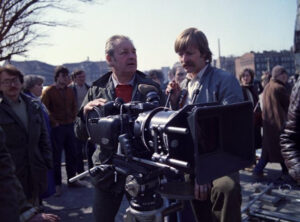
As noted by the historian and film expert Krzysztof Kornacki: ‘Another feature rendering Wajda’s film unusual is the very short timeframe between the groundbreaking events and the making of the picture: it is only a few months. Consequently, Man of Iron was able to grasp the August 1980 mood and specific customs almost in statu nascendi. Perhaps the attitude towards the prototypical events would have been different had the picture been shot in the autumn of 1981, when public mood and attitudes towards Solidarity were gradually changing. Let us add, however, that Man of Iron was a record-breaking feature film in terms of production. It took six months to make this picture – a film with momentum – which was something unprecedented in Polish cinematography at the time. Man of Iron is also complete in terms of its content, as it refers to the entire complexity of the Solidarity movement.’
Wajda’s film is essentially a panorama of the socio-political history of Poland in the years 1968–1980. The fate of its protagonists is set against the background of the successive social revolts of March 1968, December 1970, June 1976 and August 1980, and the film’s narrative ends with the signing of the Gdańsk Agreement.
Krzysztof Kornacki opined as follows: ‘Wajda’s film portrays the strike at the shipyard as a moral sanation, which is expressed, inter alia, by the ban on alcohol consumption – so that the protest and decisions are carried out by sober minds (this theme appears several times, and most clearly in the scene in which Winkel observes with regret the alcohol poured out by the worker in front of the gate). Yet the most important thing is solidarity – not yet institutional, but interpersonal, which is expressed most profoundly in the scene in which Tomczyk’s colleagues, who are in prison, bring Agnieszka the money they collected at the shipyard. From a moral point of view, Wajda’s picture is Manichean – the security service functionaries and executives of the regime’s television are morally despicable, while the protesting workers and members of Solidarity, nobly monumental (Tadeusz Fiszbach being the only positive exception among those in power). This is also what Maciek Tomczyk is like – steadfast and nobly monumental. Equally important from a moral and, incidentally, dramatic point of view, is the transformation of Winkel, the editor, who – under the influence of contacts with workers and people supporting the strike – undergoes an evolution, resigning from his job at the Radio and Television authority.’
The character of the alcohol-addicted, life-weary, opportunistic journalist entangled in various rotten compromises (played by Marian Opania) is extremely interesting also because, in a sense, he personifies the entire journalistic milieu of the Polish People’s Republic, who, in the 1970s, were skilfully implicated by the state authorities in disseminating the so-called propaganda of success. In fact, this propaganda collapsed only in August 1980. It was then that some journalists, emboldened by the workers’ protest and the previous information policy of the state authorities, joined the open opposition and became involved in the creation of the Solidarity media, independent of the Polish United Workers’ Party.
Wajda’s film is also the apotheosis of the working class, whose representatives are shown as professionals knowing their worth, and citizens aware of their rights. Incidentally, one of them is the main character of the film, Maciej Tomczyk, who at one point deliberately dropped out of university and chose for himself the fate of an ordinary worker at the Gdańsk Shipyard employing several thousand people, and it was there that he came into contact with representatives of the anti-communist opposition.
It is highly significant that Maciej Tomczyk – the protagonist of the film – is the son of a former 1950s socialist labour leader, Mateusz Birkut. His father (and also the main protagonist of Man of Marble) only realised after some time that he had been misled by the communist system and used against other workers. In this way, the erstwhile labour leader came to question the system that had moulded him.
Originally, Wajda intended to show Birkut’s death in Gdynia in December 1970 in Man of Marble, but realising that the censors would not allow such a scene to be shown, decided against it. The situation changed, however, as a result of the emergence of Solidarity and its taking up of the subject of the December 1970 massacre. What had been impossible five years prior, was finally shown in Man of Iron.
The film also utilises numerous archival film and sound materials from the pacification of the Coast in December 1970, which would have been unthinkable in the 1970s. The picture is also enriched with footage from the Polish Film Chronicle and excerpts from the popular documentaries Sierpień [August] (directed by Ireneusz Engler) and Robotnicy ’80 [Workers of ’80] (directed by Andrzej Chodakowski and Andrzej Zajączkowski) made in the early 1980s.
The final scenes of the movie were musically illustrated with a song performed with bravado by Krystyna Janda, ‘Ballada o Janku Wiśniewskim’ [The Ballad of Janek Wiśniewski], telling the story of Gdynia’s ‘Black Thursday’ of 17 December 1970. Speaking of music, it is worth mentioning that the film also features the unofficial anthem of the Gdańsk Shipyard’s striking workers, i.e. ‘Piosenka dla córki’ (A Song for My Daughter) by Maciej Pietrzyk.
Wajda’s film is filled with religious themes and numerous references to Catholicism, which would undoubtedly also have been blocked by government censorship before 1980.
Another thread that must have been inconvenient for the communist authorities was the way in which Wajda portrayed the pre-August anti-communist opposition activists, of whom Maciej Tomczyk was one. In the film, they were portrayed as people who were unbroken, morally pure, and totally devoted to Poland and the fight for individual freedom. This image completely contradicted that of so-called anti-socialist elements and political extremists created by the official media of the Polish People’s Republic at the time.
Despite numerous attempts at interference from censors, Wajda decided to remove only a single scene from the film, one depicting a drowning man being fished out of the Motława River – an activist from the ‘KOR’ (Komitet Obrony Robotników) Social Self-Defence Committee.
The film was shot in Gdańsk and Gdynia. It was praised primarily for its documentary qualities, but it simultaneously attracted quite a lot of criticism from some reviewers, who emphasised that it was characterised by the excessive sentimentalism and naïveté of the plot, and that some characters (such as Maciej Tomczyk and his wife Agnieszka) were overly idealised and monumental. Some critics even accused Wajda of unwittingly copying the patterns of socialist realist cinema.
The film also contains obvious historical misrepresentations, such as repeating the common opinion that students did not support the workers’ demonstrations in December 1970, and giving false information about there being no strikes on the Gdańsk Coast in June 1976. In fact, the strike at that time involved the entire first shift of the staff of the Gdańsk Shipyard (numbering 10,000 in total) and several smaller plants. As repression for their participation in the protest, the authorities fired more than 100 workers involved in the June strike. It was therefore not true, as the authors of the film suggest, that, in June 1976, nobody in Gdańsk (apart from the fictional character Maciej Tomczyk) supported the protesting workers from Radom, Ursus, and Płock.
The picture has received numerous awards and distinctions both locally and abroad. It received the Palme d’Or at the 34th Cannes International Film Festival (1981) and the Solidarity Award at the Polish Film Festival in Gdańsk (1981). It was also nominated for a César Award (1982) and an Academy Award (1982).
Man of Iron was released in Polish cinemas on 26 July 1981, and was seen by more than five million viewers until the imposition of martial law. After 13 December 1981, it was banned from cinema screens for political reasons.
Wajda’s film is a rarity in Polish cinematography, as no other feature film has received such strong support from the Solidarity trade union. The unionists wrote petitions, letters and appeals to the state authorities for the quick screen release of the picture, and also warned them against possible censorship actions.
To this day, Man of Iron is the most important feature film touching on the Solidarity movement, and simultaneously one of the most famous films in Andrzej Wajda’s oeuvre. Although the director returned to the Solidarity theme in some of his later works, he never again managed to create an equally outstanding work.
Author: Piotr Brzeziński – PhD, historian and an employee of the Solidarity Legacy Institute (Instytut Dziedzictwa Solidarności)
Translation: Mikołaj Sekrecki